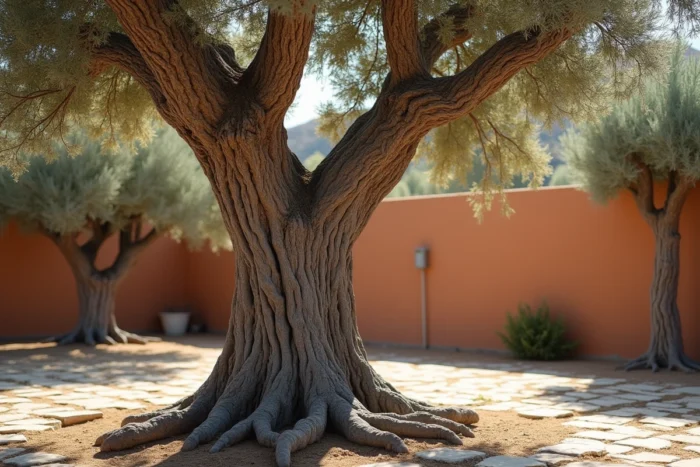
An olive tree that does not bud in spring while its neighbors are already covered with new shoots is the kind of situation that raises questions. Is the tree simply in prolonged dormancy or permanently doomed? The distinction is not obvious, because an olive tree can remain leafless for months and then sprout from the base. Knowing how to recognize a dead or declining olive tree requires a few precise actions.
The bark test on an olive tree: the only reliable check
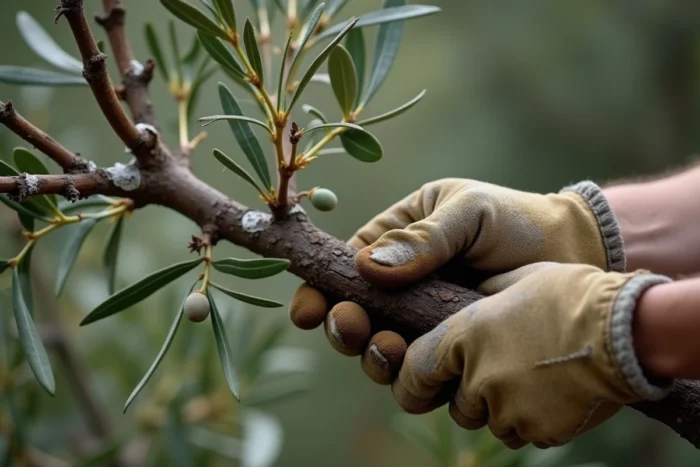
We always start here in the field, even before looking at the leaves. The principle is simple: scrape the bark of a twig with your nail or the blade of a knife for a few centimeters. If the wood under the bark is green and slightly moist, the twig is alive. If it is brown, dry, and brittle, it is dead.
One dead twig is not enough to condemn the tree. It is necessary to test several areas at different heights: tips of branches, main branches, and then the trunk itself. We gradually move downwards. As long as we find green somewhere, the olive tree retains the ability to recover.
When scraping reveals dry wood all the way to the main trunk, including at the base, the situation is critical. One often overlooked point: it is also necessary to check at the collar (the junction between the trunk and the roots). Some olive trees only sprout from this area, sometimes several months after a destructive episode. To deepen this diagnosis, one can learn how to recognize a dead olive tree by crossing several criteria beyond simple scraping.
Late frost and heatwave: when the climate dooms a garden olive tree
Classic content on the decline of olive trees talks about watering or diseases. In the field, the most brutal cause of mortality remains frost, especially when it occurs after an early sap rise.
The mechanism is violent. Water in the tree’s tissues freezes, cells burst, and the trunk can literally crack along its entire length. The winter of 1956 killed about three million olive trees in southern France. This type of damage occurs more locally during late spring frosts when the tree has already started to restart.
A trunk split longitudinally after a frost episode is almost always irreversible. Deep cracks expose the heartwood to fungi and moisture. The tree does not heal quickly enough to close the wound.
The sequence of late frost followed by a summer heatwave is particularly destructive. The tree weakened by frost no longer has enough conductive tissue to hydrate properly during the heat. A rapid and complete drying of the canopy is then observed within a few weeks, with watering making no difference.
Specific signs of frost damage on olive trees
- Bark peeling off in large plates, revealing blackened wood underneath, not just dry
- Vertical cracks on the trunk or main branches, appearing during winter or very early spring
- Total absence of budding even though the season is advanced, including at the base of the trunk and at the level of suckers
Brown leaves on an olive tree: distinguishing normal renewal from decline
An olive leaf lives about two to three years before yellowing, browning, and falling off. This natural renewal mainly concerns the inner and lower leaves of the canopy. It is normal and does not signal any problem.
The warning sign is when leaves brown at the tips of the twigs, where growth is supposed to be active. If the young shoots of the year dry up, the tree is no longer renewing its foliage; it is losing it.
Another reliable indicator: the speed of the phenomenon. Normal renewal spreads over weeks, with leaves gradually falling. True decline causes rapid and massive browning, sometimes in less than fifteen days, often accompanied by a dull and grayish appearance of the remaining foliage.
Excess water or dehydration: two opposing causes, identical brown leaves
This is the classic trap. An overwatered olive tree and a thirsty olive tree produce the same visible symptom: browning and curling leaves. The difference lies in the soil.
- Soggy soil or compact earth that does not drain: roots suffocate, rot, and the tree can no longer absorb water despite its presence. There is often a musty smell at the base of the tree
- Dry soil deep down, cracked earth, absence of watering for weeks in summer: classic dehydration, easier to correct if addressed in time
- Well-drained soil but the tree is still in decline: suspect a root problem (fungus, verticillium wilt) or frost damage not visible on the surface
A potted olive tree is much more vulnerable to excess water than one in the ground, because the limited substrate volume concentrates moisture around the roots. Opinions vary on this point, but the majority of reported declines in potted olive trees by amateur gardeners are related to insufficient drainage rather than a lack of watering.
Olive tree without leaves in spring: wait or uproot
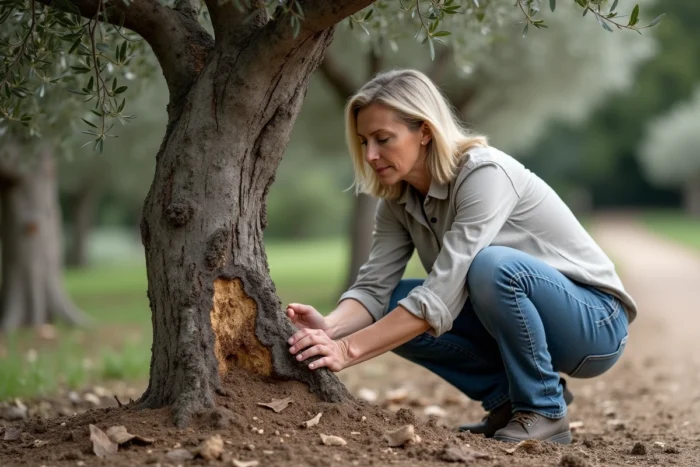
An olive tree completely defoliated in May is not necessarily dead. The decision to wait or uproot depends on the result of the bark test and the condition of the trunk.
If scraping reveals green at the collar or on at least one main branch, we wait. Some olive trees take up to two full seasons to produce new shoots after severe stress. Cutting the tree too early deprives the stump of its reserves.
If all the wood is dry from top to bottom, the trunk sounds hollow when tapped, and no shoots appear at the base despite a whole spring passing, the tree is dead. This can be confirmed by cutting a main branch: uniformly brown and brittle wood, with no trace of moisture or green, leaves no room for doubt.
The last resort before deciding to uproot: water moderately at the base throughout a spring and observe. A living olive tree will always eventually produce at least a few weak adventitious shoots at the collar or directly on the trunk. The total absence of vegetative response after a complete season of favorable conditions remains the most reliable diagnosis to confirm the death of the tree.