
You have just found the ideal sedan in Germany or the perfect SUV in the United Kingdom. The price is attractive, and the mechanics seem solid. Before you can legally drive in France, your imported vehicle will need to go through a technical step called individual vehicle approval, often referred to as “passage aux mines.” This procedure checks that the vehicle complies with French safety and emissions standards. Understanding how it works can prevent weeks of delays and unexpected expenses.
Weight tax and retroactive penalty: the tax system that changes the game in 2026
Before even thinking about the technical inspection, one parameter deserves your attention: the fiscal cost of importing. Environmental taxation has significantly tightened in 2026, with a weight tax threshold dropping to 1,500 kg. Many used SUVs and thermal sedans are affected, including models that seem modest.
An additional measure directly targets imported vehicles. A retroactive penalty applies to vehicles that were exempt at the time of their first registration (diplomatic vehicles, inclusion mobility card, for example) when they are resold to a non-exempt buyer. If you buy a used vehicle abroad that benefited from an exemption in its country of origin, this penalty can represent a significant amount.
In practice, simulate the total fiscal cost before signing the purchase. An attractive vehicle at the time of purchase may lose all its appeal once the weight tax and penalty are added. All the preliminary steps before the passage aux mines of an imported car should be anticipated, including tax considerations.
Individual vehicle approval: how the DREAL inspection works
You have purchased your vehicle and calculated the taxes. Let’s move on to the inspection itself. The individual vehicle approval (RTI) is the system that replaces, for an individual vehicle, the type approval obtained at the factory by manufacturers on their production models.
Why this procedure exists
A vehicle built for the German or Japanese market does not necessarily meet the same specifications as a vehicle sold in France. The headlights, reflective plates, speedometer, or emissions levels may differ. The RTI checks compliance with French requirements point by point.

The role of the DREAL and the CNRV
The inspection is carried out by the DREAL (Regional Directorate for the Environment, Planning and Housing) of your region, or by the CNRV (National Vehicle Reception Center) as applicable. You make an appointment, present the vehicle and your documents. An inspector conducts a physical and documentary examination.
Do you have a vehicle from the European Union with a valid European Certificate of Conformity (COC)? In this case, the procedure is simplified. The COC certifies that the vehicle has already been type-approved in a member state. The DREAL then mainly checks that the vehicle matches the data on the COC.
For a vehicle from a country outside the European Union (Japan, United States, post-Brexit United Kingdom), the procedure is more complex. Additional tests may be required, and certain physical modifications to the vehicle may sometimes be necessary to achieve compliance.
Documents to prepare for the registration of an imported vehicle
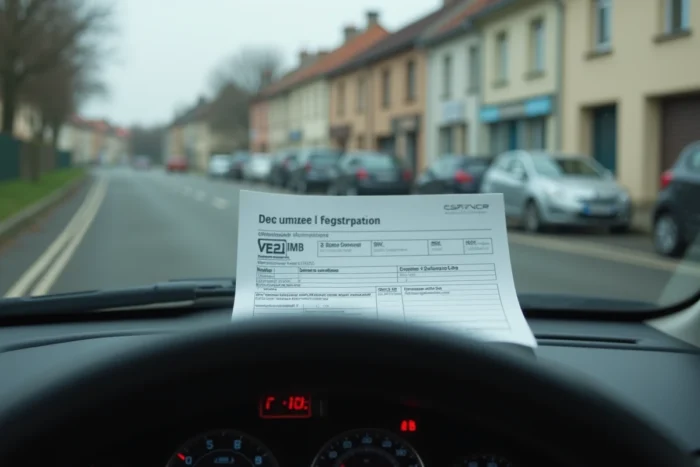
The success of the passage aux mines depends as much on the documentation preparation as on the condition of the vehicle. An incomplete file can delay the appointment by several weeks.
Here are the documents to gather:
- The foreign registration certificate (carte grise from the country of origin), original and preferably accompanied by a sworn translation for countries outside the European Union.
- The European Certificate of Conformity (COC) if the vehicle comes from the EU, or failing that, the technical documents from the manufacturer justifying the vehicle’s characteristics.
- A valid French technical inspection, carried out at an approved center in France (or its recognized equivalent for certain EU countries, dated within the last six months).
- The tax clearance certificate issued by the tax office, certifying that VAT has been paid or is not due.
- An identity document and proof of residence, as for any registration request via the ANTS.
The tax clearance certificate is often the document that blocks files. It must be requested from the business tax office (SIE) in your department before submitting the registration application. Without this document, the ANTS will refuse the file.
Temporary WW plates and driving while waiting for the registration certificate
Between the purchase abroad and obtaining the final registration certificate, how can you legally drive? The temporary WW registration plates allow you to drive on French territory during the duration of the procedures.
Upon entering France, your vehicle must have valid registration plates. If the foreign plates have expired, you risk immobilization by law enforcement. Some countries issue temporary export plates, the validity of which varies.
Starting in 2026, WW plates will be subject to stricter rules, with enhanced monitoring of their validity period. If you are importing a vehicle, plan to request your WW plates as soon as the procedure begins to avoid being stuck without the ability to move the vehicle to the inspection center.
EU or non-EU approval: two very different paths
The administrative process varies radically depending on the origin of the vehicle.
For a vehicle purchased in a European Union country, the European Certificate of Conformity simplifies the procedure. The DREAL validates the correspondence between the COC and the vehicle presented. The total time, from purchase to registration certificate, is counted in a few weeks if the file is complete.
For a vehicle from outside the EU, the individual vehicle approval involves thorough technical checks. The vehicle may require modifications (lights, mirrors, pollution control devices) before meeting French requirements. The timeline extends, and the budget increases proportionally.
The difference in complexity between these two paths justifies checking, before any purchase, whether the targeted model has type approval recognized in Europe. A model sold in Europe by the manufacturer will almost always have a COC available, which significantly shortens the procedure.
Each step, from the tax clearance certificate to the WW plates and through the RTI, forms a chain. A missing link is enough to block the whole process. The best strategy remains to prepare the complete file before initiating the transport of the vehicle to France.