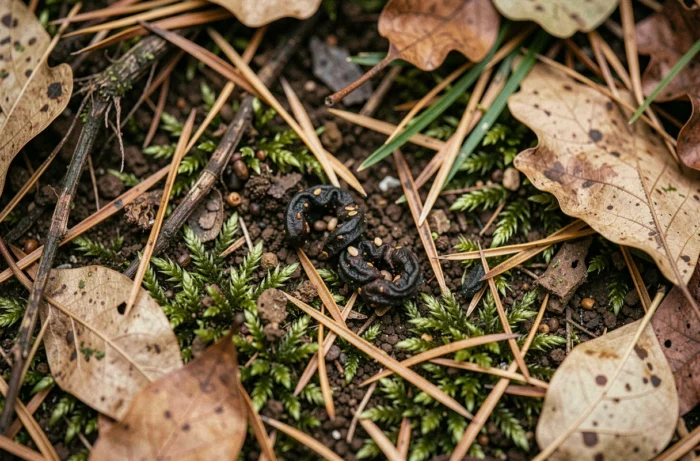
Identifying the animal that visits a garden or an attic at night rarely starts with direct observation. Nocturnal species evade the eye, and it is their droppings that provide the first usable clue. Recognizing the droppings of nocturnal animals requires considering several criteria: shape, size, texture, as well as the location of deposition and visible food remains. A photo alone is not always sufficient, as diet, ambient humidity, and aging significantly alter the appearance of the same dropping.
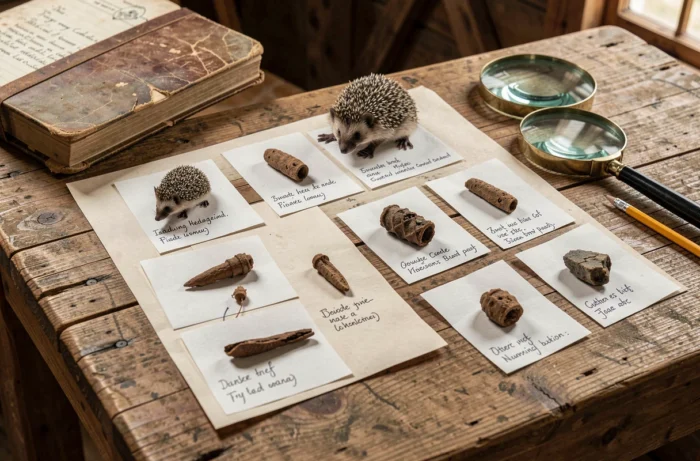
Comparative table of common nocturnal animal droppings
Before examining each case in detail, a summary table allows us to establish the discriminating criteria. The descriptions below are based on characteristics documented by naturalist guides and pest control professionals.
| Animal | Indicative Size | Shape | Texture / Feature | Typical Deposit Location |
|---|---|---|---|---|
| Mouse | Very small (grain of rice) | Thin spindle, pointed ends | Hard, dark, smooth | Along baseboards, drawers, cupboards |
| Brown rat | Larger than a mouse dropping | Stout spindle, rounded ends | Shiny when fresh, darkens quickly | Near food sources, cellars, pipes |
| Dormouse / fat dormouse | Intermediate between mouse and rat | Elongated oval | Often mixed with fruit fragments | Attics, lofts, nesting boxes |
| Martens | Significantly larger | Twisted, irregular | Strong odor, contains fur or seeds | Roof, car hood, woodpile |
| Bat (guano) | Small, similar to mouse | Grainy, crumbly | Crumbles and reveals shiny fragments of insect shells | Under a high resting point |
| Hedgehog | Medium | Cylindrical, rounded | Black, shiny, contains insect remains | Lawn, flower beds, terrace |
| Fox | Large | Elongated, often tapered | Musk odor, various debris (berries, fur) | Paths, field edges, walls |
This table provides an initial framework for understanding. The differences in size and texture between closely related species warrant a more detailed examination, outlined in the following sections. Photographic resources can help refine visual comparisons, such as those available on the planete-animaux.fr website, which offers images categorized by species.
Nocturnal rodent droppings: distinguishing mouse, rat, and dormouse
The most frequent confusion concerns rodents. Mice and rats both leave dark spindle-shaped droppings, but the size difference is clear once you pay attention. Mouse droppings resemble a black grain of rice, with pointed ends. Those of the brown rat are noticeably larger, with ends that are often rounded.
The location of deposition helps to clarify. Mice scatter their droppings all over their path, including in drawers and behind furniture. Rats concentrate their droppings more near their feeding areas or along regular routes, often in cellars or near pipes.
The case of the dormouse and the fat dormouse in the attic
Dormice and fat dormice occupy attics and lofts. Their droppings, of intermediate size, are distinguished by the frequent presence of fragments of fruit or seeds in the material. This feature reflects a more varied diet than that of the common house mouse. If you find droppings in an attic with visible plant remains, the hypothesis of a dormouse or fat dormouse is more likely than that of a rat.
Bat guano and marten droppings: two visual traps
The resemblance between bat guano and mouse droppings often leads to mistakes. Both are small and dark. The texture test clarifies the issue: guano crumbles easily between the fingers (protected by gloves) and reveals shiny fragments, remnants of insect shells. A mouse dropping, on the other hand, remains compact and resistant to pressure.
The location of discovery often confirms the diagnosis. Bats deposit their guano directly under their resting point, high up: beam, window lintel, closed shutter. A localized accumulation on the ceiling or under a facade crack clearly points to this species.
The marten, recognizable by its odor and contents
Marten droppings are larger, twisted, and emit a strong characteristic odor. They regularly contain fur, feathers, or fruit pits. They can be found on roofs, in attics, but also on the hoods of cars parked under a shelter. The marten often deposits its droppings in the same spot, forming a small pile that accumulates over several days.

Limits of visual identification and health precautions
No photo identification method is infallible. The color of a dropping varies according to the animal’s diet, and aging alters the shape and consistency within a few days. A fresh, shiny, and soft rat dropping can become grayish and crumbly after a week.
Mobile apps for photo identification provide assistance, but their reliability depends on the quality of the picture and the state of the dropping. Systematically comparing the result with the location of discovery and the texture remains the safest method.
Handling and disinfection
The health aspect is often absent from visual guides. Rodent droppings, in particular, can carry pathogens. A few precautions reduce the risk of contamination:
- Never sweep or vacuum dry, as this stirs up potentially contaminated particles
- Moisten the droppings with a disinfectant before picking them up, while wearing disposable gloves
- Ventilate the room during and after cleaning to refresh the ambient air
This cleaning step is crucial for the safety of the occupants as much as the identification itself.
Cross-referencing clues for reliable identification
Shape and size provide an initial orientation. The location of deposition refines the diagnosis. Texture and visible food content often help distinguish between two closely related species. Three cross-referenced criteria are better than a single hastily taken photo.
- Shape and size: pointed spindle (mouse), rounded spindle (rat), oval with plant fragments (dormouse), twisted (marten), crumbly with shards (bat)
- Location: baseboards and cupboards (mouse), cellars and pipes (rat), attics (dormouse, bat, marten), lawn (hedgehog), paths (fox)
- Visible content: shiny insect fragments (bat, hedgehog), fur and feathers (marten), seeds and fruits (dormouse, fox)
Identification becomes more reliable when at least two independent criteria are combined. An attic, intermediate-sized droppings, and fruit remains: the dormouse is the most likely candidate. Small crumbly droppings under a beam: the bat is the clear choice. This cross-referenced approach compensates for the limitations of a simple photographic examination and allows for directing the appropriate response, whether it involves gentle exclusion or professional treatment.