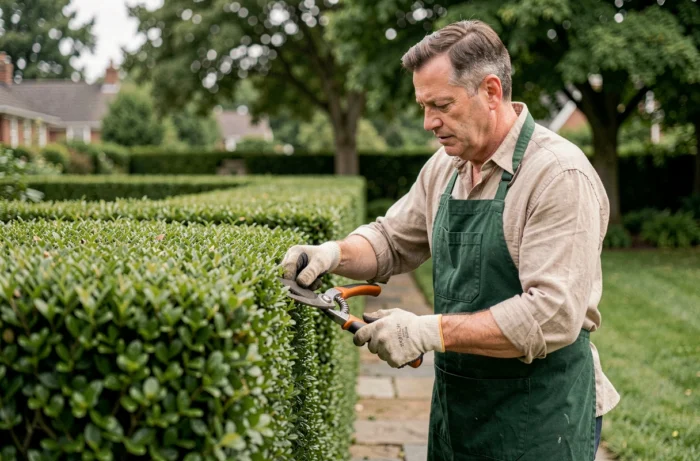
The size of a hedge relies on a precise technical gesture: orienting the cut so that light reaches the base of the plant. Without this logic, even a vigorous shrub will become bare at the bottom in just a few seasons. Trimming and sculpting a hedge is not just about shortening branches; it’s about directing growth to achieve a dense and uniform shape throughout its height.
Trapezoidal profile: the geometry that determines hedge density
Most guides mention the trapezoidal shape without explaining why it works. The principle is physiological: a base wider than the top ensures uniform sunlight across the entire face of the hedge. When the top exceeds the base in width, the lower branches receive too little light, stop producing foliage, and eventually dry out.
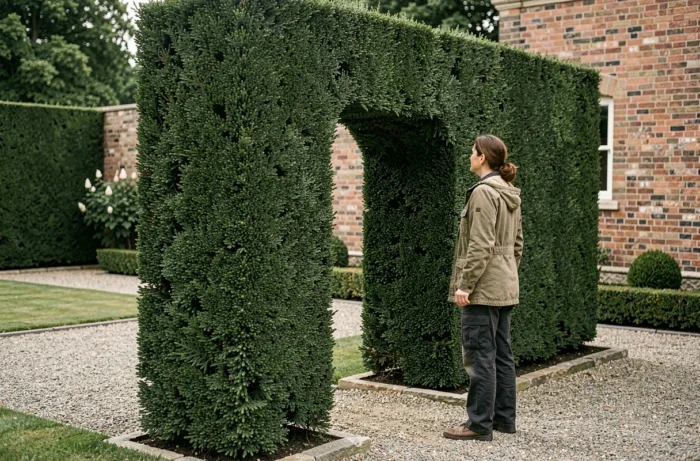
For conifer hedges (thuja, Leyland cypress), this profile is even more crucial. These species do not regrow on old wood. A lower bare area becomes permanent. Trimming with the sides slightly angled inward, with a visible width difference between the base and the top, remains the only way to maintain an opaque green curtain throughout the hedge’s lifespan.
Specifically, each pass of the blade should follow an upward motion, from the bottom to the top, while keeping the device slightly tilted. A string line stretched between two stakes helps maintain the line of the top, but it’s the angle of the sides that makes the real difference between an amateur result and a professional one. The resources available on sculpte-haie.com detail the angles suitable for each type of shrub.
Hedge trimming and nesting: a regulatory constraint often overlooked
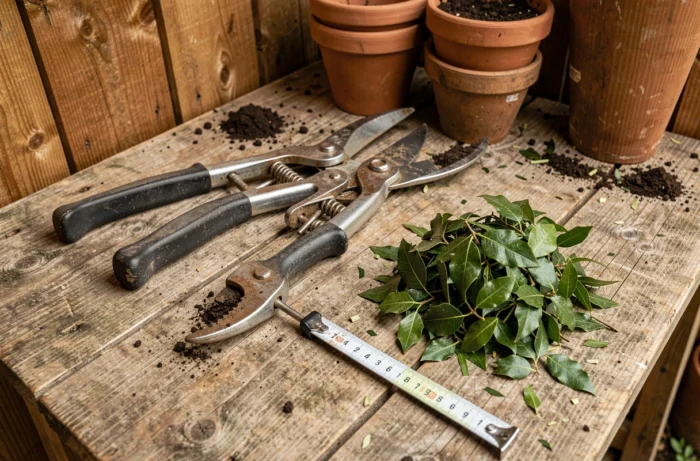
The trimming schedule does not solely depend on the growing season of the shrubs. In France, the destruction of a nest of a protected species can be sanctioned under Article L.415-3 of the Environmental Code. This provision applies year-round, not just in spring.
Common recommendations advise avoiding the period from March to August. This timeframe covers the peak of nesting, but a late nest can halt work even in September. Caution involves visually inspecting the hedge before each intervention: gently parting the foliage at eye level and checking for the absence of active nests.
For hedges in agricultural areas, the regulations are now more structured, with a ban on work of at least 21 weeks defined locally according to prefectural orders. Individuals are not subject to the same framework, but species protection applies to all.
Sculpting a hedge in topiary: cutting technique on young wood
Topiary is not limited to French gardens. Any hedge of boxwood, privet, or hornbeam can take on a geometric or rounded shape, provided a fundamental rule is followed: only cut the wood of the year. Young wood, recognizable by its lighter color and flexibility, heals quickly and produces new lateral shoots.
Cutting into old wood creates gaps in vegetation that can take several seasons to fill, or may never fill in certain evergreen species. To sculpt a rounded shape, the technique involves working in successive passes:
- Rough out the general silhouette with hedge trimmers, keeping a margin of a few centimeters from the intended final shape
- Refine the curves with hand shears, which offer more precise control over small areas
- Regularly step back several meters to assess the symmetry of the whole, as alignment defects are invisible up close
For complex shapes (spiral, ball on a stem), a wire template placed around the shrub serves as a cutting guide. This template is removed once the shape is established and is only used for the initial trims. After two or three seasons, the plant’s memory of shape is sufficient to maintain the silhouette with simple maintenance.
Maintenance of blades and quality of cut on branches
A poorly sharpened hedge trimmer does not cut: it crushes. Crushed branches heal poorly, turn brown in a few days, and become entry points for fungi. Sharpening the blades before each trimming session improves both the visual result and the health of the shrub.
On an electric or battery-operated device, sharpening is done with a flat file, following the original angle of each tooth. A wipe with a cloth soaked in pine resin after use prevents sap from hardening on the blade. Dried sap creates additional friction that slows cutting and strains the motor.
- Check the gap between the two blades: a gap that is too large allows small branches to slip without being cut
- Clean the motor vents after each use to prevent the accumulation of plant debris
- Replace the blades when sharpening no longer achieves a clean cut on a branch the size of a pencil
The pruner remains the necessary complement to the hedge trimmer for branches over one centimeter in diameter. Forcing a hedge trimmer on wood that is too thick damages the mechanics and produces an uneven cut that harms regrowth.
Trimming frequency according to hedge type
Fast-growing hedges (privet, cherry laurel, hornbeam) require two to three trims per year to maintain a neat silhouette. Conifer hedges are generally trimmed twice: once at the end of spring, and again at the beginning of autumn before the slowdown of vegetation.
Free or wild hedges (hawthorn, hazel, dogwood) only require an annual trim, often at the end of winter. Their interest lies in flowering and fruiting, which frequent cuts can suppress. For these hedges, the pruner takes precedence over the hedge trimmer: branches to be removed are selected rather than cutting them back to the ground.
The last trim of the season, regardless of the species, should occur early enough for new shoots to harden before the first frosts. Tender wood exposed to the cold freezes, splits, and leaves open wounds that weaken the hedge for the entire following season.