Underwater diving encompasses very different practices, from simple snorkeling at the surface to exploring submerged caves with specific gas mixtures. For a beginner, this diversity can be confusing: each type of diving involves its own level of training, equipment, and safety constraints. Understanding these distinctions before getting in the water helps guide your progression and avoid unpleasant surprises.
Medical certificate and diving: a regulatory constraint often underestimated
Since 2022, the medical certificate is no longer mandatory for most sports under federal practice. Underwater diving is one of the exceptions. Classified among disciplines with specific constraints, it requires an annual medical certificate, dated less than a year ago, regardless of the structure (FFESSM affiliated club or commercial center).
This requirement applies to all practitioners, beginners and experienced alike. A diving baptism supervised by an instructor can sometimes be done based on a simple health questionnaire, but as soon as it involves qualifying training or regular practice, the certificate remains a non-negotiable prerequisite. ENT, cardiac, or pulmonary pathologies are given special attention during this examination.
This regulatory framework is worth knowing before choosing a type of diving, as it conditions access to training. You can learn more on Sortie 24 to identify practices that correspond to your situation.
Scuba diving, freediving, and snorkeling: what really separates them
The term “diving” covers at least three activities with radically different logics. Confusing them risks engaging in unsuitable training or purchasing unnecessary equipment.
Snorkeling
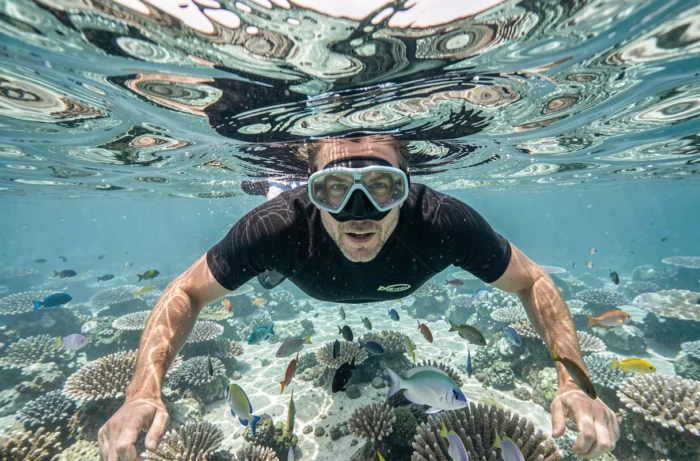
Snorkeling is practiced at the surface with a mask, snorkel, and fins. No tank, no mandatory certification training. It is the most accessible entry point to discover underwater life, especially on shallow reefs.
Its limits are clear: you stay at the surface or a few meters deep. Pressure management, ascent, and decompression are not an issue. Snorkeling does not prepare you for scuba diving, but it allows you to familiarize yourself with the aquatic environment and test your tolerance to the mask.
Freediving: a discipline in its own right
Freediving is not just about holding your breath. It relies on breathing techniques, muscle relaxation work, and structured progression. FFESSM clubs offer specific training, distinct from that of scuba diving.
The equipment is minimalist (mask, long fins, wetsuit, weight belt), but the physiological risks are real: hypoxic syncope, barotrauma, loss of consciousness at the surface. Serious training addresses these risks from the very first sessions.
Scuba diving
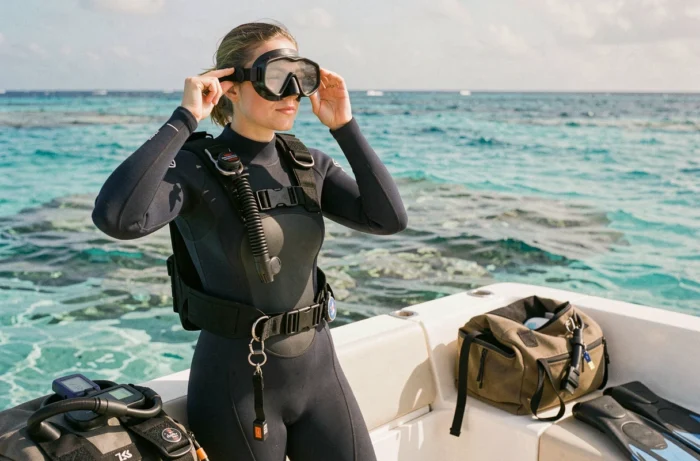
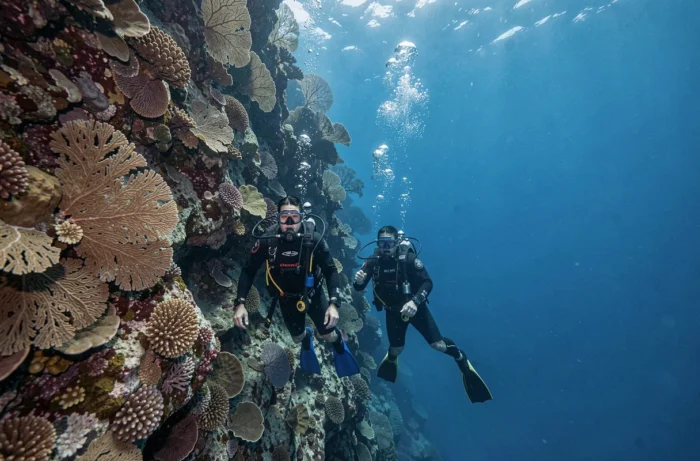
Scuba diving uses a compressed air tank and a regulator to breathe underwater. It is the most common practice and the one that opens access to specialties (wreck, deep, night, nitrox). Each level of certification sets a maximum authorized depth, regulated by the sports code in France.
The basic equipment includes:
- A mask, fins, and a wetsuit suitable for the water temperature
- A buoyancy control device to manage buoyancy and a regulator connected to the tank
- A dive computer that calculates in real-time the depth, immersion time, and decompression stops
- A safety stop buoy (to signal your position during ascent)
Investing in a personal dive computer is often recommended from the beginning of training, as it allows you to monitor your own parameters rather than those of the instructor.
Scuba diving specialties: which ones to aim for first
Once the first level is obtained (Level 1 FFESSM or Open Water PADI), several specialties become accessible. Not all are equal in terms of the balance between technical difficulty and diving pleasure.
Wreck diving is the most sought-after specialty by newly certified divers. It combines exploration, history, and marine life attached to metal structures. However, penetrating a wreck (entering inside) requires additional training and rigorous management of orientation and air consumption.
Night diving radically changes the perception of the environment. The nocturnal fauna differs from the diurnal fauna, and managing lighting becomes a skill in itself. It is a technically accessible specialty but requires a good level of comfort underwater.
Deep diving, beyond 40 meters, involves gas mixtures (nitrox, trimix) and more complex decompression planning. It is aimed at experienced divers. For a beginner, aiming for deep diving too early is counterproductive: managing nitrogen narcosis and ascent protocols requires solid prior experience.
Pressure, ascent, and stops: the physiological basics not to be neglected
Regardless of the type of scuba diving practiced, hydrostatic pressure remains the central factor. At each depth increment, pressure increases and alters the behavior of gases dissolved in the body.
The ascent is the most critical phase. A too-rapid ascent can cause a decompression accident, potentially serious. Decompression stops, calculated by the dive computer, allow dissolved nitrogen to be gradually eliminated. Ignoring these stops exposes you to neurological and joint risks.
For a beginner, two reflexes to instill:
- Never hold your breath during ascent (risk of pulmonary overpressure)
- Always respect the three-minute safety stop, even when the computer does not formally require it
- Regularly monitor your air consumption, not just at the beginning and end of the dive
Field feedback varies on the usefulness of manual dive tables compared to modern computers. Most training continues to teach them as a backup tool, but in practice, the dive computer has become the reference tool for managing decompression in real-time.
The choice of a type of diving depends as much on the technical level as on the targeted environment. A beginner diver who accumulates about thirty dives in varied conditions (current, reduced visibility, cold water) builds a much stronger foundation than one who repeatedly dives in the same tropical lagoon. Progression comes from the diversity of sites and conditions, not just from accumulating certifications.