
The textile manufacturing process involves a long chain of transformations, fragmented across several countries, and increasingly scrutinized by regulations. Displaying the locations of production, weaving, dyeing, and finishing: online sellers must now make this information accessible in France. This framework requires viewing each production stage not merely as a technical link but as an environmental control point.
Textile finishing and carbon footprint: the link that brands prefer to keep quiet
When discussing textile manufacturing, attention often focuses on fiber cultivation or final assembly. However, the intermediate stages—dyeing, washing, and chemical finishing, grouped under the term finishing—account for a massive share of emissions and water consumption.
Reducing the carbon footprint of a textile factory without shifting pollution to its suppliers remains the central issue. A brand can showcase an energy-efficient assembly workshop in France while outsourcing dyeing to countries with less stringent discharge standards. Finishing represents the most emission-intensive stage of the textile chain, and it is precisely here that traceability has long been lacking.
Current strategies of industrial players are moving towards a more energy-efficient finishing process, with low-temperature dyeing methods or mechanical treatments replacing certain chemical finishes. The available data does not yet allow for measuring the actual extent of these transitions at the sector level, but regulatory pressure is accelerating the movement.
To delve deeper into each transformation phase, textile manufacturing on Boulevard Mode details the complete journey from fibers to the finished product.
Fibers, spinning, and weaving: how the choice of raw material changes everything
The textile production process begins with the selection of fibers. Natural fibers (cotton, linen, wool, silk) or synthetic fibers derived from petrochemicals (polyester, polyamide): this initial choice conditions everything that follows, from the type of spinning to the applicable weaving techniques.
Spinning: turning fiber into thread
Spinning converts raw fibers into usable threads. For cotton, this involves carding (untangling and aligning fibers), drawing, and then twisting. For synthetic fibers, the process differs: a melted polymer is extruded through spinnerets to obtain continuous filaments.
The choice between short fiber and continuous filament determines the strength and feel of the final fabric. A carded cotton thread has neither the same structure nor the same behavior as a polyester filament, which directly influences the possibilities for weaving or knitting.
Weaving and knitting: two construction logics
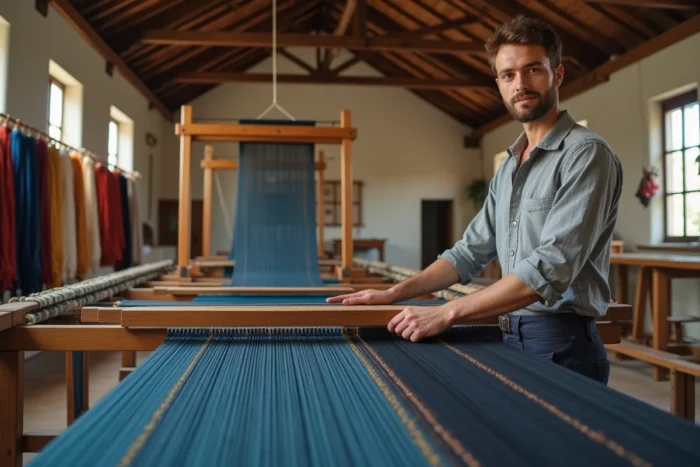
Weaving interlaces two series of threads (warp and weft) on a loom to produce a stable fabric. Knitting, on the other hand, forms successive loops that give the fabric its elasticity. These two techniques serve distinct purposes:
- Weaving produces rigid fabrics suitable for shirts, trousers, or upholstery, with high mechanical strength
- Knitting allows for soft stitches used for t-shirts, underwear, or sportswear, with a natural stretch capacity
- Tufting and felting, less known, serve specific applications like carpets or industrial felts
The type of fabric construction directly influences material loss during cutting. A knitted fabric deforms more during cutting, complicating pattern optimization and generating more waste.
Assembly and material loss: the hidden cost of cutting
Assembly, the final major step, transforms the fabric into a finished product. It includes pattern making (creating cutting templates), cutting, sewing assembly, and finishing. This is also the stage where material losses become visible and measurable.
The fabric scraps generated during cutting represent a structural waste of the industry. Reducing these losses involves the digital optimization of cutting plans, where software interlocks pattern pieces to maximize the use of each meter of fabric. Despite these tools, material losses remain a significant issue that few brands communicate about.
In France, assembly workshops that master the entire process, from cutting to finishing, remain modestly sized structures. Their competitiveness against ultra-fast fashion does not rely on volume but on the ability to limit waste and add value to scraps (recycling, upcycling, resale to designers).

Anti-fast fashion law and traceability: the new regulatory framework in France
The ultra-fast fashion law has established a framework that the French textile industry has never known. The text introduces targeted penalties against the most polluting practices and prohibits certain forms of advertising for very low-cost textile products.
Traceability of manufacturing, weaving, dyeing, and assembly locations is now mandatory for textiles sold online in France. This obligation is not limited to stating “made in”: it requires displaying environmental information associated with each stage.
This framework changes the game for textile factories seeking to reduce their carbon footprint. Displaying the location of each production stage makes visible the use of subcontractors in countries with less stringent environmental standards. However, field feedback diverges on the actual effectiveness of this system: without systematic control, the display may remain declarative.
Extending lifespan: an industrial lever
Sector strategies are no longer limited to new production. Second-hand, repair, and extending the lifespan of clothing are now presented as full-fledged industrial levers. Some textile companies integrate repair workshops or take-back systems directly into their business model.
This shift modifies the very definition of textile manufacturing: producing a durable, repairable garment, whose fibers can be reinjected into a production cycle, becomes a competitiveness criterion against the volumes of ultra-fast fashion. Producing less but producing to last redefines the manufacturing process from fiber choice to seam strength.
The French textile sector finds itself at a tipping point. The current regulatory framework imposes a transparency that, if effectively applied, could redistribute the cards between local production and low-cost imports. The coming years will reveal whether this mandatory traceability is sufficient to change practices or if it will remain a display without operational consequences.