
What parameters to measure, how often, and how to adjust actions over the months for a saltwater pool? The answer lies less in a checklist of tasks than in understanding the thresholds that affect water quality. This article presents a structured calendar based on measurable data: salt level, pH, chlorine production, and the state of the electrolysis cell.
Operating thresholds by brand of electrolyzer
The required salt level varies by manufacturer. Using the wrong concentration reduces chlorine production or triggers a safety alarm. The table below summarizes common ranges.
| Parameter | Low range | High range | Note |
|---|---|---|---|
| Salt level (generic) | 3 g/L | 7 g/L | Varies according to the manufacturer’s instructions |
| Optimal pH | 7.0 | 7.4 | Above 7.6, produced chlorine loses effectiveness |
| Minimum water temperature | 15 °C | – | Below this threshold, electrolysis stops automatically |
| Seawater (comparison) | 35 g/L | – | Pool concentration remains ten times lower |
Your device’s manual remains the reference. A deviation of a few grams per liter from the recommended range is enough to reduce the cell’s efficiency or accelerate the scaling of the titanium plates.
Establishing a maintenance schedule for saltwater pools starts by noting these thresholds in your technical documentation, then transferring them to a tracking notebook or dedicated app.

Frequency of salt and pH checks by season
Most guides recommend weekly checks. This frequency is correct in summer, but it should be adjusted according to the season.
Spring: Restart and first adjustment
At the end of winterization, when the water temperature exceeds 15 °C, the electrolyzer resumes its cycle. This is the time to measure the salt level, pH, and TAC (total alkalinity). Salt is added all at once, dissolved directly in the pool, with filtration running.
A shock treatment (shock chlorine compatible with electrolysis) eliminates microorganisms accumulated during winter. Salt does not replace shock chlorine during startup.
Summer: Weekly checks and production adjustment
Heat, UV rays, and pool usage accelerate chlorine consumption. During this period, pH and free chlorine levels are checked weekly. Salt recombines after acting: the natural cycle of electrolysis limits additions to one or two times per season.
- Check pH twice a week if the temperature exceeds 28 °C, as heat accelerates the upward drift
- Adjust chlorine production on the electrolyzer unit based on the measured temperature
- Clean the skimmer basket and pump pre-filter to maintain a constant filtration flow through the cell
Autumn and winter: Gradual slowdown
When the water temperature drops below 15 °C, the electrolyzer goes into safety mode. Filtration runs in reduced mode (active winterization) or stops (passive winterization). No salt addition makes sense as long as the cell is not producing.
During active winterization, a monthly pH check is sufficient. In passive winterization, the cover protects the pool, and maintenance is limited to a visual inspection of the equipment.
Maintenance of the electrolysis cell: when and how to descale
The cell is the most expensive component of the system. Its scaling is the primary cause of failure. The titanium plates accumulate limescale deposits proportionally to the hardness of the water and the duration of operation.
A cleaning every three to four months serves as a reliable guideline. In hard water (high TH), this interval may shorten. Descaling is done by soaking the cell in a mild acid solution (white vinegar or a specific product provided by the manufacturer).
Some recent electrolyzers include a polarity reversal function that slows scaling. This technology does not eliminate manual cleaning but spaces out its frequency.
- Visually inspect the cell each month for white deposits on the plates
- Soak the cell in the descaling solution for the duration specified by the manufacturer, without scraping the plates
- Rinse thoroughly before putting the cell back into service
- Record each cleaning in the tracking notebook to anticipate the next one
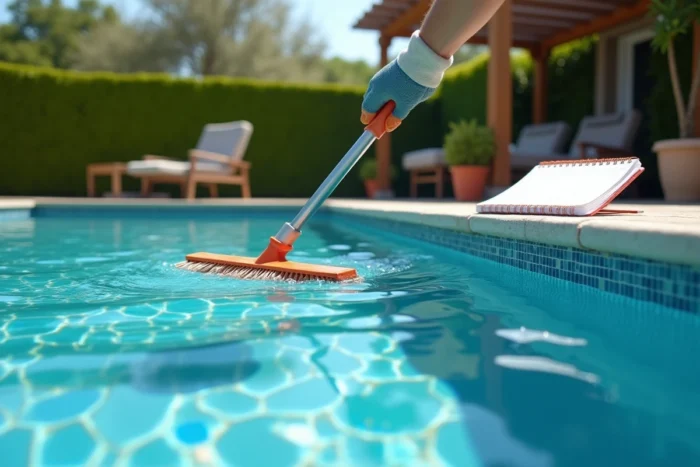
Water restrictions and maintenance schedule for saltwater pools
Prefectural orders related to drought directly affect pool management. As soon as the alert level is reached, filling is limited. In heightened alert, specific hours may be imposed. At the crisis stage, filling and leveling are prohibited, except for safety imperatives on an inground pool.
This constraint requires integrating strategies for conserving existing water into the schedule: systematic covering after each swim, tracking leaks in the hydraulic circuit, and forgoing total drainage as a catch-up solution.
Planning the pool restart early in spring, before summer restrictions, allows for supplementary filling under better regulatory conditions.
Traceability of measurements: what professional frameworks can inspire
The order of June 23, 2026, issued under articles D.1332-1 and D.1332-10 of the Public Health Code, updates the requirements for monitoring and recording water parameters for pools subject to health regulations. Domestic pools are not subject to this, but the measurement frequencies and alert thresholds defined for public facilities provide a useful reference.
Recording each measurement (salt, pH, free chlorine, temperature) in a dated table allows for spotting deviations before they degrade water quality. A simple spreadsheet or paper notebook is sufficient. Connected pool systems automate this traceability, but the tool matters less than the consistency of measurement.
An effective maintenance schedule for saltwater pools relies on three measurable pillars: adherence to the manufacturer’s salt range, weekly pH monitoring during the season, and regular descaling of the cell. The rest, filtration, mechanical cleaning, covering, naturally complements this.