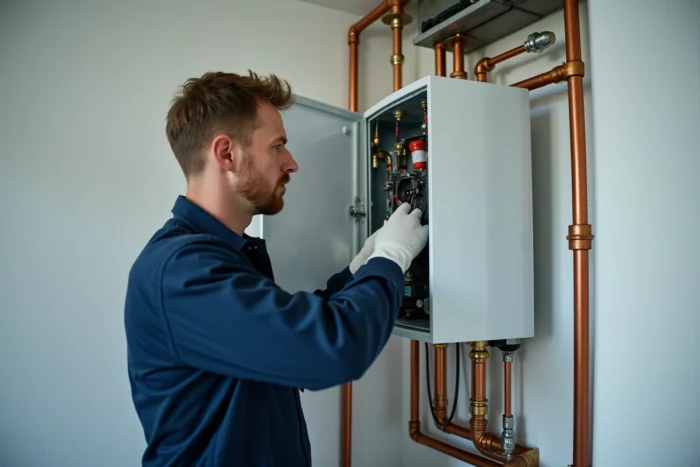
A boiler that struggles to restart after six months of summer inactivity is the classic scenario during the first weeks of cold in Brussels. The problem almost never stems from a sudden breakdown: it’s an accumulation of minor issues (low pressure, combustion residues, worn seals) that turns the restart into a hassle. Preparing your boiler maintenance before winter is primarily about avoiding this situation.
Restarting after summer: what goes wrong in Brussels boilers
We often see the same pattern in September-October. The boiler has been running at low capacity or not at all for months. The hydraulic circuit has lost pressure, sometimes below the minimum threshold displayed on the pressure gauge. The sealing joints, subjected to expansion cycles without water circulation, deteriorate faster than one might think.
On condensing gas boilers, the condensate trap can dry out during the summer. The result: upon restarting, unpleasant odors arise, and the boiler goes into safety mode. A technician can fix this in a few minutes, but without prior intervention, you might find yourself without heating on a Saturday night.
Brussels housing adds a layer of complexity. Many old buildings have shared heating columns, outdated chimney ducts, or connections that haven’t been reviewed in years. We discussed in detail boiler maintenance in Brussels on Butterfly Mag, particularly the constraints specific to the capital’s architecture.
Legal obligation in Brussels: frequency and certification for gas or oil boilers
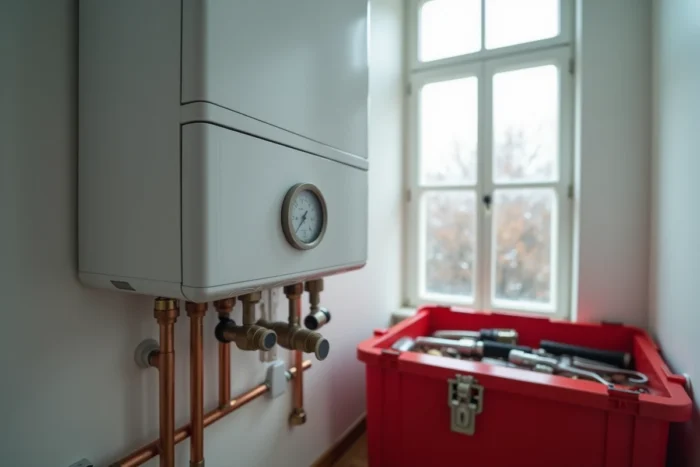
All gas boilers in Brussels must be serviced every two years, regardless of power. This is a peculiarity of the Brussels Region: in Wallonia, the frequency depends on the threshold of 100 kW, but in Brussels, even a small domestic boiler is subject to this biennial obligation.
For oil boilers, the inspection is annual. The technician must be certified and provides a combustion certificate to keep. In case of an inspection by Brussels Environment, the absence of a valid certificate can lead to penalties.
What the regulatory inspection actually covers
The professional does not just take a quick look. The regulatory maintenance includes several specific steps:
- The analysis of combustion gases, which measures the actual efficiency of the device and detects an excess of carbon monoxide (CO) in the fumes
- The cleaning of the burner, heat exchanger, and, for condensing models, the condensate drainage trap
- The verification of the water circuit pressure, expansion vessel, and the general condition of the connections
- The inspection of the flue gas outlet, a critical point in old buildings where collective chimneys may have cracks
The certificate issued at the end of the inspection mentions the numerical results of the combustion analysis. This document serves as legal proof in case of a claim covered by your home insurance.
Cost of boiler maintenance in Belgium: what influences the bill
The average cost of boiler maintenance in Belgium ranges from 110 to 210 euros, depending on the type of device. A classic gas boiler remains at the lower end of this range. Condensing models and oil boilers cost more because cleaning takes longer and combustion analysis requires additional measurements.
The recent trend is a moderate increase, driven by rising labor and travel costs for technicians. Some professionals offer annual or biennial maintenance contracts that include priority troubleshooting. A maintenance contract reduces the risk of extra costs in case of a winter breakdown, but feedback on this point varies depending on the provider and the actual coverage of the contract.

Tenant or owner: who pays for maintenance
In Brussels, the routine maintenance of the boiler is the responsibility of the tenant. This includes the mandatory periodic inspection and cleaning. The replacement of the device or the repair of a hidden defect remains the responsibility of the owner.
In practice, many Brussels leases do not clearly specify this distribution. Check your lease agreement before planning the intervention, especially if you have recently occupied the property.
Warning signs before a breakdown: when to call a heating technician
Waiting for a complete breakdown is the worst strategy. Several concrete signs indicate that maintenance or repair is necessary before the winter restart:
- The boiler takes longer than usual to reach the requested temperature, a sign of a clogged heat exchanger or a poorly adjusted burner
- Unusual noises (clanking, hissing, gurgling) at startup, often related to trapped air in the circuit or a worn circulation pump
- A yellow or unstable flame instead of a steady blue flame on a gas boiler, indicating incomplete combustion and a risk of CO production
- Signs of moisture or rust around the device, which may indicate a leak in the hydraulic system
On boilers over fifteen years old, these symptoms occur more frequently. A certified technician can assess whether it is better to repair or replace the installation. Replacing it with a condensing model significantly improves efficiency, but the initial investment remains substantial.
Scheduling maintenance in summer: the right reflex to avoid congestion
Brussels heating technicians are overwhelmed between October and December. Making an appointment in July or August guarantees a quick slot and, with some providers, a slightly lower rate during the off-peak period.
Planning your boiler maintenance in summer allows you to fix a problem before the first ignition. If the technician detects a part that needs replacing, the order and follow-up intervention can be done without urgency, outside of peak times for spare parts.
One last practical point: remember to bleed your radiators after the technician’s visit. The air accumulated in the circuit during the summer reduces heating performance and forces the boiler to consume more to reach the set temperature.