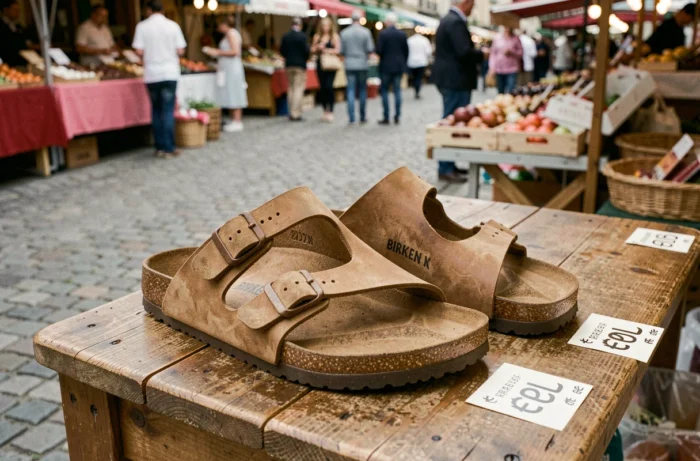
The current prices of Birkenstock regularly exceed 100 euros for an entry-level model, a level that raises eyebrows. Understanding why the price of Birkenstock in France remains high requires examining the brand’s overall pricing strategy, its margins, and the increasing control it exerts over its distribution.
Birkenstock Financial Results: Margins and Revenue
Birkenstock’s quarterly reports directly shed light on its pricing policy. The brand boasts a gross margin of around 60%, a ratio more commonly found in luxury than in mass-market footwear.
| Indicator | Recent Data | What This Means for the Consumer |
|---|---|---|
| Gross Margin | About 60% | Selling price significantly higher than production cost |
| Revenue Growth Europe | Double digits, at full price | Demand absorbs price increases without notable resistance |
| Full Price Sales vs Promotions | High proportion of sales without discounts | No significant downward pressure |
| Owned Store Target (Europe) | 53 by the end of September 2026 | Fewer intermediaries, more uniform pricing |
Several factors explain the price of Birkenstock in France, starting with this financial structure that leaves no room for discounts. As long as buyers accept the catalog price and the margin remains at this level, nothing compels the brand to lower its prices.

Distribution in France: Why Birkenstock Promotions Remain Rare
Birkenstock took over distribution in France in 2021, a shift that changed the market structure.
Before this takeover, wholesalers and independent retailers offered occasional discounts. Price differences between retailers created opportunities for consumers. The vertical integration ended these pricing wars and eliminated most of the clearance sales that lowered perceived prices.
The target of 53 owned stores in Europe by the end of September 2026, mentioned in an interview with Paris Match, extends this logic. The more the brand controls its points of sale, the more freely it sets retail prices.
- The takeover of French distribution in 2021 reduced the number of players likely to offer discounts
- Owned stores sell at catalog prices, with no negotiation margin for the customer
The remaining partner retailers adhere to a strict commercial framework, aligned with the brand’s pricing policy. The model is comparable to that of luxury houses, which are gradually removing their products from multi-brand channels.
From Orthopedic Comfort to Near-Luxury: The Birkenstock Repositioning
The price level cannot be explained solely by distribution. Birkenstock has undergone a comprehensive repositioning, shifting from a manufacturer of functional sandals to a premium fashion reference.
Entering the orbit of major luxury players has accelerated this trajectory. It reflects an alignment with industry codes: controlled scarcity, refusal of clearance sales, and upgrading of materials. Producing less than the market could absorb is a classic lever to maintain high prices.
Leather, Cork, and German Manufacturing: Real Costs and Brand Image
The cork and latex sole, the leather straps, the assembly in Germany: these elements generate production costs higher than those of a sandal made in Southeast Asia. This manufacturing cost alone does not suffice to explain a gross margin of 60%.
The quality of materials also serves as a positioning argument. The consumer pays for the product, but also for the brand image, the orchestrated rarity, and the orthopedic heritage associated with Birkenstock.
Exchange Rates and Tariffs: External Pressures on the Pricing Structure
Exchange rate fluctuations weigh on the group’s profitability. Birkenstock reported an unfavorable exchange impact of 350 basis points for the year, a figure that compresses consolidated results.
The 15% U.S. tariffs on European imports do not directly affect pricing in France. However, they influence the brand’s overall strategy. When the dollar weakens, the margin on U.S. sales decreases, which may prompt Birkenstock to maintain its prices in Europe to preserve overall balance.
Birkenstock Imitations: A Price Protection Strategy
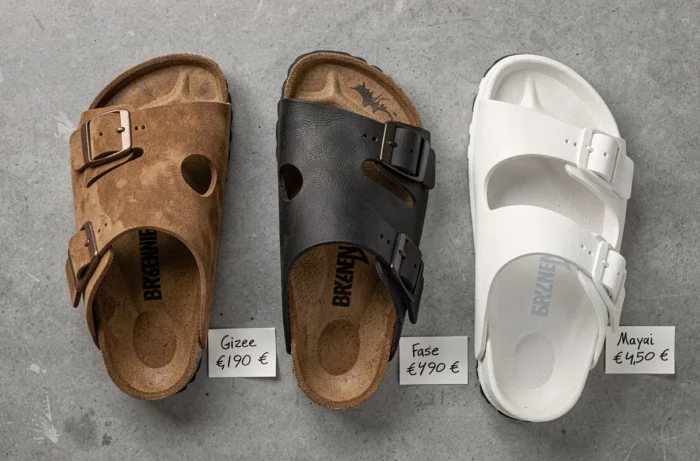
The market for imitations has grown in recent years, both online and in stores. The brand has chosen a firm approach to defend its iconic models.
This strategy aims to prevent the erosion of perceived value. If low-priced copies spread without opposition, consumers would eventually question the price of the original. By protecting its models, Birkenstock also safeguards its pricing structure.
The high price of Birkenstock in France results from a set of converging decisions: a gross margin characteristic of luxury, a takeover of distribution, deliberate scarcity, and active defense of intellectual property. Full-price demand remains strong in Europe, and as long as it does, none of these levers have any reason to weaken.