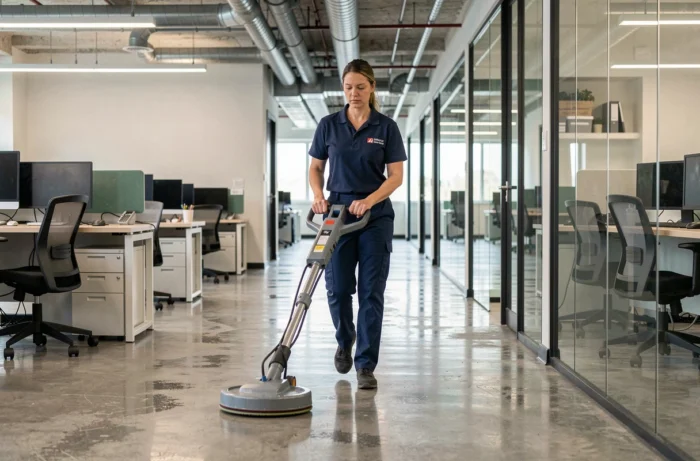
The professional cleaning of offices and that of industrial sites are often grouped under the same commercial label. Service providers offer “innovative solutions” without distinguishing the regulatory frameworks, ventilation constraints, or documentation traceability obligations specific to each environment. Comparing these two worlds allows for measuring the real gap between technical requirements and choosing the right tools for each context.
Biocide Regulation and Ventilation: What Separates Offices and Industrial Sites
Office cleaning relies on standardized protocols: dusting, disinfecting contact points, and floor maintenance. The products used most often belong to eco-certified ranges, and the documentation obligations are limited to standard safety data sheets.
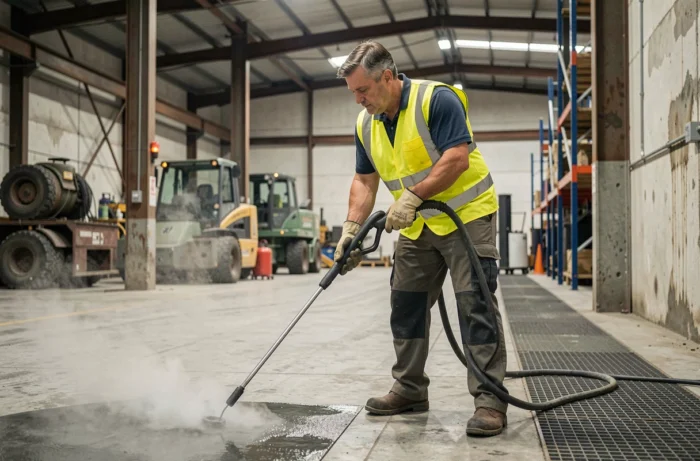
On an industrial site, the situation changes. Disinfection products applied in food or pharmaceutical production areas are subject to the European biocide regulation, which requires a specific market authorization, batch tracking, and proof of effective contact times. A provider that transfers a “office” protocol to a packaging workshop without adaptation exposes itself to non-compliance during health audits.
Ventilation illustrates the same discrepancy. The UNI EN 15780:2025 standard governs the cleaning of air handling systems for civil, commercial, and tertiary buildings but explicitly excludes systems related to an industrial process. A chemical production site or a clean room falls under distinct references, with cleanliness classes and intervention frequencies unrelated to those of an open space.
Specialized providers in multi-site maintenance, such as those listed on horizonnet.be, structure their interventions by distinguishing these two scopes right from the specifications.
Document Traceability: The True Marker of Professional Maintenance
Online competitors highlight autonomous robots, IoT sensors, and real-time tracking applications. These innovations are real, but they mask a more structural point: the digital traceability of interventions has become the main audit criterion, both in tertiary and industrial settings.
A timestamped intervention log, tracking of the batches of products used, photographic proof of the result, and centralization of quality controls constitute the required foundation during unannounced audits. Without this documentary layer, a scrubbing robot or a foot traffic sensor proves nothing to an inspector.
What a Complete Traceability File Should Contain
- Timestamped intervention sheets identifying the agent, site, and treated area
- The batch number of each biocide or detergent used, along with its expiration date
- Proof of compliance with contact times for disinfectants, ideally via a digital validation system
- Periodic quality control reports, signed by the site manager and the service provider
In a tertiary environment, this traceability often remains optional: it serves customer relations and the Qualipropre or ISO 9001 certification. In an industrial setting, it becomes a regulatory obligation conditioning the continuation of activity.
Comparison of Requirements Between Office Maintenance and Industrial Cleaning
The table below summarizes the technical and regulatory gaps between the two environments based on the most discriminating criteria.
| Criterion | Offices / Tertiary | Industrial Sites |
|---|---|---|
| Disinfection Products | Eco-certified detergents, no specific authorization required | Biocides subject to market authorization, mandatory batch tracking |
| Ventilation and Air Handling Systems | UNI EN 15780:2025 applicable | Specific sectoral references, excluded from EN 15780 standard |
| Document Traceability | Recommended for quality certification | Mandatory, audited periodically |
| Typical Intervention Frequency | Daily to weekly depending on areas | Continuous or multi-daily depending on cleanliness class |
| Agent Qualification | Internal training, no sector-specific certification required | Specific authorizations (Certibiocide, chemical risks, ATEX depending on the site) |
This table shows that a high-performing provider in the tertiary sector is not automatically operational on an industrial site. The qualifications of the agents are the first selection filter for a production site manager.
Cleaning Drones and Regulatory Scenarios STS-01 and STS-02
Among recent innovations, drone cleaning mainly concerns high-rise glass facades and industrial roofs. The technology exists and works, but its deployment in urban areas requires a precise regulatory framework.
Operations in the specific category require compliance with the standard scenarios STS-01 or STS-02, which define flight conditions (distance from people, altitude, area flown over) and require pilot qualification. A provider offering facade cleaning by drone without mentioning these scenarios in their commercial offer does not master the operational framework.
- STS-01 covers flights in direct view over sparsely populated areas, with mass and distance constraints
- STS-02 allows flights out of direct view but imposes enhanced safety measures and dedicated airspace
- The pilot’s qualification must be up to date and adapted to the scenario declared to the competent authority
For a tertiary building manager in the city center, using a drone remains marginal. For a large industrial site with hard-to-reach roofs, it represents a measurable safety gain compared to human intervention at height.
Choosing Between Material Innovation and Documentary Rigor
Robots, sensors, and drones provide real operational gains. They do not replace the documentary structuring required by industrial references. A reliable provider combines both dimensions: the tool suited to the field and the evidence usable in audits.
The choice of a professional maintenance solution is not made from a catalog. It begins with identifying the applicable regulatory framework, followed by verifying the qualifications and traceability capacity of the provider. Without this step, any innovation remains a commercial argument without technical grounding.