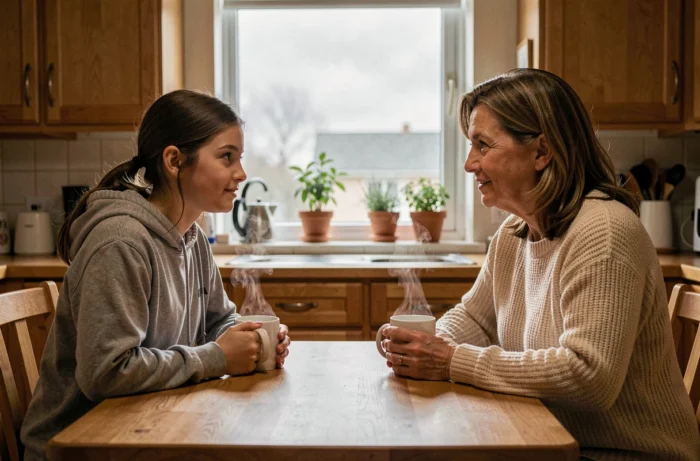
Staying at home instead of going to class can address a real need: accumulated fatigue, anxiety, relational issues at school or high school. Convincing your mother to grant you a day off requires understanding what motivates her refusal, and then formulating a credible request. The arguments that work are not the same depending on the situation, and some may backfire.
Occasional school refusal or warning sign: distinguishing between the two cases
Before looking for the right wording, ask yourself an honest question: why do you want to stay home? The answer changes the strategy.
An article from Sud Ouest published on September 15, 2026, reminds us that a repeated refusal to go to class can signal a health or safety issue. Signs to take seriously include: unusual fatigue, withdrawal, sleep disturbances, marked irritability, recurring physical symptoms. In this case, the approach is not to convince your mother to let you skip school, but to explain what you are feeling so she can take action.
On this subject, you can read this article on Muchos that details the different possible approaches depending on your family situation.
However, if the request is for just one day to unwind, recover after an intense week, or prepare for an exam, the persuasive levers are different. The table below summarizes the two configurations.
| Situation | What your mother hears | Recommended approach |
|---|---|---|
| Occasional discomfort (fatigue, temporary stress) | “My child wants to skip school” | Propose a specific plan for the day (study, structured rest) |
| Repeated refusal over several weeks | “Something is wrong” | Talk openly about the problem, accept support (doctor, school counselor, school nurse) |
| Bullying or cyberbullying | “My child is in danger” | Name the situation, contact 3018 (free, anonymous, 7 days a week from 9 AM to 11 PM) |

Concrete arguments to convince your mother to stay home
Your mother needs specific reasons, not a vague complaint. The difference between a categorical refusal and permission often lies in how you present your request.
Show that you have a plan for the day
A parent’s first instinct when faced with “I don’t want to go to school” is to fear a wasted day in front of a screen. Proposing a schedule counters this argument. Specify what you plan to do: catch up on a difficult chapter, sleep two more hours then study, prepare a presentation in advance.
A written schedule for the day reassures more than a verbal promise. If you can show that you will be productive, resistance decreases significantly.
Choose the right moment to talk about it
Bringing up the subject on the morning itself, five minutes before leaving, puts your mother in a stressful position. She refuses by default, lacking time to think. Discuss it the night before, during a calm moment. Explain the reason, present your plan, and give her time to consider.
The timing of the request matters as much as the arguments.
Acknowledge the limits of the request
Asking for a day off works once in a while. If the request comes up every week, no argument will hold. Your mother knows this, and so do you. Showing that you are aware of this (for example: “I won’t ask next week”) reinforces your credibility.
Errors that lead to a systematic refusal from parents
Some approaches produce the opposite effect of what is intended. Knowing them helps avoid blocking the discussion.
- Grossly simulating an illness: complaining of vague stomach aches without any visible symptoms rarely works with an attentive parent. If you are found out, trust is damaged for a long time.
- Crying or shouting to force a decision: emotional pressure may work once, but it then triggers lasting distrust. Your mother will associate every future request with manipulation.
- Comparing with other families: “Theo’s mother lets him stay home” is an argument that annoys most parents. It says nothing about your situation and gives the impression that you are looking for a loophole rather than a dialogue.
- Providing no reason: a simple “I don’t feel like it” gives your mother nothing to justify her decision, even to herself. Even a modest reason (“I’m exhausted, I need to recover”) is better than nothing.
When staying home is no longer enough: health and school support
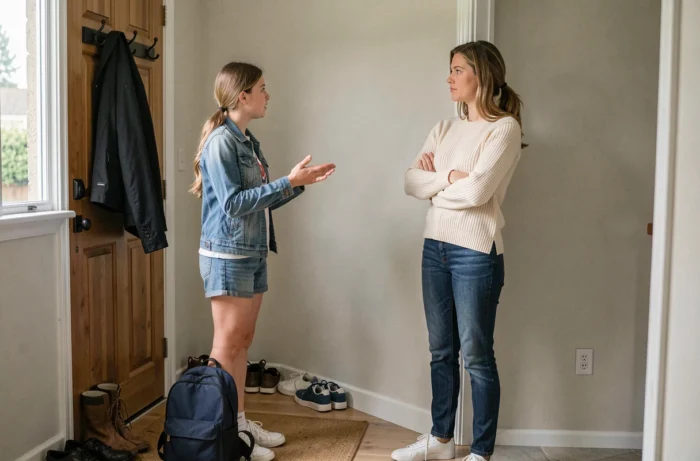
If the desire to stay home becomes permanent, the question goes beyond parental persuasion. The EnCLASS survey reports that the feeling of loneliness affects 21% of middle school students and 27% of high school students. This figure shows that school distress is not exceptional.
The Ministry of Solidarity specifies that school bullying can lead to anxiety, isolation, eating disorders, depression, or suicidal behavior. The 3018 is free, anonymous, and confidential, accessible 7 days a week from 9 AM to 11 PM. This service is available to both students and their parents.
At the school level, the homeroom teacher, the school counselor, and the school nurse are the first contacts.
Getting a day at home can address a legitimate need for recovery. The key remains transparency with your mother: a well-reasoned request, made at the right time, with a concrete plan, is likely to succeed. If the need to stay home arises often, it is a signal that deserves to be heard by a trusted adult, not just circumvented.