The organizational burden of a family cannot be resolved with lists of good intentions. It is managed like a system, with concrete trade-offs regarding the available time, money, and energy. Building a fulfilling family life on a daily basis requires establishing a realistic framework before seeking harmony.
Family budget and social policies: what will change concretely in 2026
A joint report from the General Inspectorate of Finance (IGF) and the General Inspectorate of Social Affairs (IGAS), submitted in 2026, proposes 4.2 billion euros in savings over ten years on family policies, while these represented 122.1 billion euros in 2024. Among the suggested measures: lowering resource ceilings for certain allowances, eliminating the tax reduction for education expenses in secondary and higher education, and ending certain tax benefits for single or widowed parents.
For families, these measures, if implemented, would directly reduce financial maneuverability. A couple with two children in higher education would lose a significant tax lever. Solo parents would be disproportionately affected.
We recommend integrating these possible changes into family budget planning now, rather than facing a sudden adjustment. A solid family budget remains the foundation of a peaceful daily life: without financial visibility, domestic tensions multiply mechanically.
Parental distribution and time spent with family: recent data
Recent studies on paternity leave and parental time show a notable evolution. Time spent with family is increasingly structured in a “tandem” father-mother model, with both parents present simultaneously with the child. This model has an advantage (educational consistency) and a rarely pointed out disadvantage: it reduces each parent’s time alone with the child.
Articles on the family section on Maman pas comme les Autres … ou Presque discuss this type of parental dynamic, where each family configuration calls for specific adjustments rather than a one-size-fits-all model.
For a parental couple to function, it is necessary to accept that each develops their own relationship with the child, even in the absence of the other. Systematically blocking time slots where only one parent manages daily tasks (meals, baths, homework) produces two measurable effects: the child adapts to different educational styles, and each adult regains their own space of responsibility.
Family poverty and single parenthood: adapting advice to economic reality
In 2024, 9.8 million people lived below the poverty line in France, representing a rate of 15.4%, the highest since 1996. Single-parent families are among the most exposed households. Talking about a fulfilling family life without integrating this data amounts to ignoring the situation of a significant portion of parents.
Family fulfillment cannot be decreed independently of material conditions. A solo mother or father juggling work, childcare, and tight budgets does not need to be advised to “put away their phone in the evening.” This parent needs concrete tools:
- Identify the aids the household is entitled to (allowances, APL, supplements) and check each year the resource thresholds, which change
- Structure the week around two or three realistic rituals (a shared meal, a free activity on the weekend) rather than aiming for an ambitious program that generates guilt
- Reach out to the local network (extended family, neighbors, community associations) to occasionally share the logistical burden
Positive parenting, widely promoted in the media, works better when the fundamental needs of the household are met. We observe that families that first stabilize their financial and logistical situation then more easily access calm educational practices.
Family rituals: building a framework without rigidifying daily life
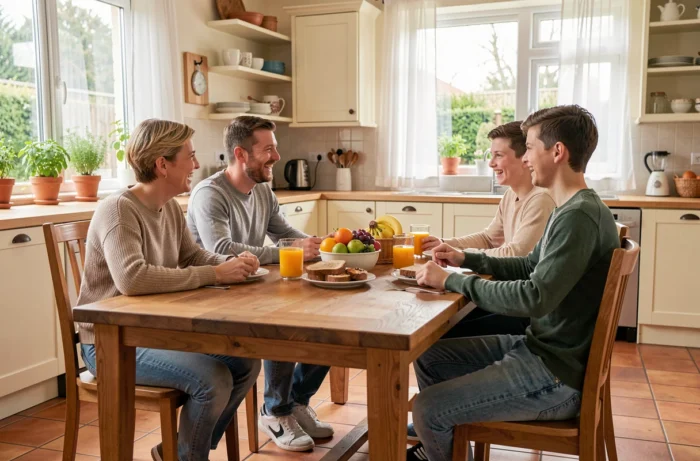
Family rituals do not serve to create an idyllic atmosphere. Their primary function is to secure children through repetition and predictability. An effective ritual is simple, reproducible, and does not depend on external conditions (weather, budget, mood).
Three criteria distinguish a lasting ritual from a good idea abandoned after two weeks:
- It requires no additional preparation (a reading moment before bed, a Sunday breakfast with a fixed menu)
- It involves all present members without forcing participation (a child can listen without speaking, a teenager can be there without visible enthusiasm)
- It remains the same regardless of the emotional context of the household (the ritual is maintained even after a difficult day, this is precisely when it plays its role)
A ritual that survives tough days is a useful ritual. Those that only work when everything is fine structure nothing.

Education and couple: protecting the parental relationship from daily life
Family life absorbs most of the available energy. The parental couple often shifts into pure operational mode: who drops off, who picks up, who does the shopping. This logistical coordination is necessary, but it does not nourish the relationship.
We recommend sanctifying a weekly time slot, even if short, where both parents discuss something other than organization. Not a formatted “date night,” but a space where the conversation does not revolve around the children. Thirty minutes is sufficient. The content matters less than the regularity.
Couples who maintain this type of exchange report a better ability to manage educational disagreements because the bond does not rely solely on co-managing the household. When the adult relationship deteriorates, tensions directly impact the family climate, and children perceive this long before parents verbalize it.
A fulfilling family life is not a stable state that one reaches and maintains. It is a moving balance, recalibrated each week according to the real constraints of the household, not external injunctions.