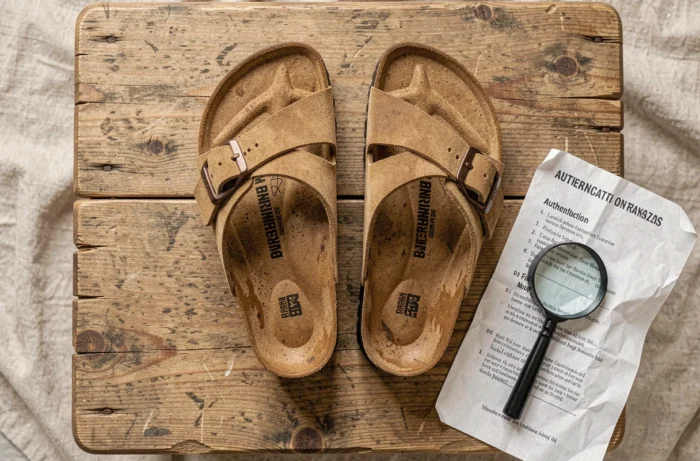
A pair of Birkenstocks bought online at a bargain price, with finishes that seem correct at first glance. Then after a few days, the cork crumbles, the sole detaches, and the promised comfort never arrives. Recognizing real Birkenstocks before purchase avoids this disappointment, and the clues to check are more precise than one might think.
Counterfeit or Birkenstock dupe: a distinction that changes everything
Before discussing authentication, it is essential to understand what is circulating in the market. For several years, Birkenstock imitations have been divided into two distinct categories.
Counterfeits reproduce the Birkenstock logo and markings to deceive the buyer. They imitate the inscriptions on the sole, the buckle, and the packaging. This is illegal, and it is this type of product that poses a real identification problem.
Dupes, on the other hand, take on the general shape of a model like the Arizona or the Boston, but do not bear the Birkenstock name. They remain in a legal gray area. An article from The Conversation republished by Boursorama in 2026 documents the rise of these acknowledged dupes, supported by consumers who openly state they did not buy the original. The stakes for you are therefore twofold: distinguish an illegal counterfeit from a tolerated dupe, and then verify the authenticity of a pair presented as original.
To delve deeper into each visual checkpoint, the differences explained on Caro Bleue Violette detail the photo references to support this.
Birkenstock anatomical sole: the test that fakes always fail
The insole, called the footbed, is the technical heart of a Birkenstock. It is also the most challenging element to reproduce faithfully for counterfeiters.
Have you ever noticed the contours under your foot when you slip on a real pair? The Birkenstock footbed has three distinct support zones: a marked arch, a deep cup at the heel, and support under the metatarsals. On a counterfeit, these contours are often flattened, poorly positioned, or simply absent.
Run your finger over the surface. Genuine cork has an irregular grain, slightly rough, with natural shade variations. Counterfeit cork appears too smooth, too uniform, sometimes with a plastic texture under your fingers.
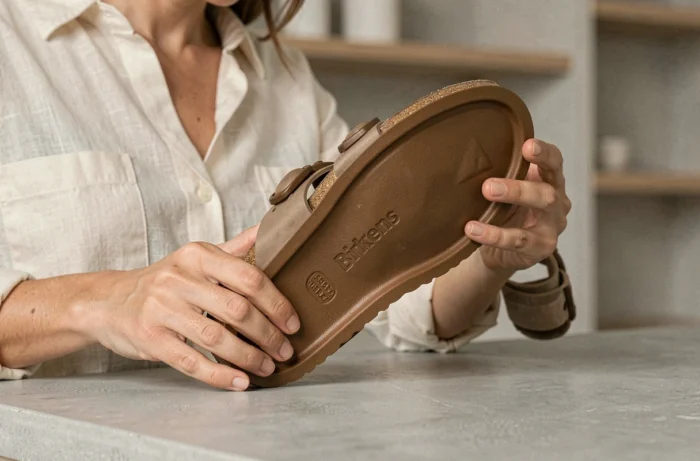
Turn the sandal over. The outsole of a genuine Birkenstock features a regular and clear herringbone pattern, with the brand name molded into the rubber. On fakes, the herringbones are often shallower, and the lettering is blurry or poorly centered.
Logo and markings on Birkenstock buckles: what the details reveal
The metal buckles are a quick and reliable checkpoint. On an authentic pair, each buckle bears the engraving “BIRKENSTOCK” in capital letters, clear and consistent. The engraving is either raised or recessed depending on the models, but always legible without effort.
Here are the elements to examine on the buckles and straps:
- The engraving on the buckle must be centered, with uniformly sized letters. An off-center engraving, too thin, or partially erased on a new pair signals a fake.
- The metal of the buckle has a noticeable weight. Counterfeits often use a lighter alloy that can be detected by touch.
- The rivets that secure the straps are flush, without burrs. Protruding or misaligned rivets betray a shoddy manufacturing process.
As for the straps, the leather or synthetic material of a genuine Birkenstock has a consistent thickness and neatly cut edges. A frayed or uneven edge on a new pair is a clear warning sign.
Price and sales channel: warning signals before purchase
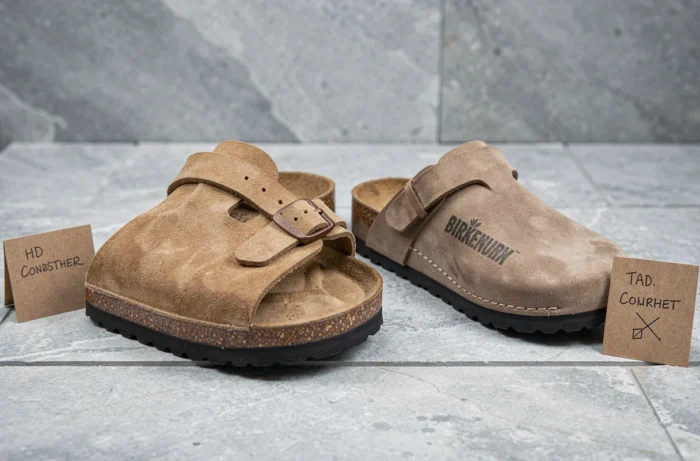
The price remains a major indicator, but not always in the way one might think. A discount greater than 40% on a recent model should raise suspicion. Birkenstock closely controls its pricing policy, including with authorized retailers. Massive sales on common models like the Arizona or the Boston outside official periods are rare among authorized distributors.
To buy online without risk, prioritize these channels:
- The official site birkenstock.com, which remains the most reliable source with a guarantee of authenticity.
- Authorized retailers listed on the brand’s website. Ensure that the seller is indeed on this list before ordering.
- Recognized multi-brand physical stores that purchase their stock directly from the official distributor.
Birkenstock has also strengthened its legal strategy in recent years, seeking to protect the very shape of its models through copyright, beyond simple trademark protection. This approach targets both counterfeiters and dupe manufacturers who too closely copy the design of the anatomical sole.
Marketplaces and classifieds: heightened caution
On peer-to-peer resale platforms, always request detailed photos of the insole, buckles, and the interior label. A seller who refuses to provide these images likely has something to hide. Compare these photos with those of the same model on the official Birkenstock site to spot discrepancies.
Listings with generic photos (reused catalog images) rather than actual photos of the product in hand are another classic signal. Similarly, a seller offering dozens of new pairs of various models at discounted prices is probably not a private individual clearing out their closet.
Original box and label: the final clues of Birkenstock authenticity
The packaging provides an additional layer of verification. The Birkenstock box bears a sticker with the model name, size, foot width (Regular or Narrow), and a barcode. The article number on the box must match the one printed on the insole.
The interior label, affixed to the footbed, mentions the European size, width, country of manufacture (Germany for most models), and a pictogram of the materials. On counterfeits, this information is often incomplete, misspelled, or printed in a font that differs from the original.
Last point of vigilance: the smell. The natural cork and leather of a genuine Birkenstock emit a characteristic earthy and slightly woody scent. A strong chemical or glue smell on a new pair indicates substitute materials, typical of low-cost counterfeits.