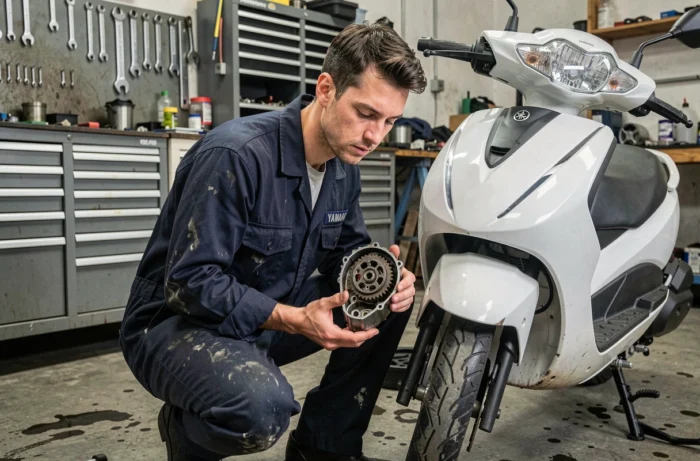
The Yamaha Xmax 125, in its recent versions, develops about 9 kW (12 hp) with a torque of 11 Nm around 6,000 rpm. Its actual top speed ranges between 110 and 118 km/h depending on the rider’s weight, the condition of the transmission, and aerodynamic conditions. Improving this maximum speed requires a precise understanding of what limits it, as well as the choice of modifications suitable for the scooter’s technical framework.
Aerodynamics and weight of the Xmax 125: the physical limits before any modifications
Before touching the mechanics, one parameter hinders speed gain ambitions: the dimensions of the Xmax 125. This maxi-scooter is wide and tall, with a frontal area much greater than that of a compact scooter like the Nmax 125. As speed increases, aerodynamic resistance grows exponentially.
In practical terms, the last km/h costs a lot of power. Moving from 110 to 118 km/h requires proportionally much more energy than moving from 80 to 90 km/h. On an engine capped at 12 hp, the available margin to push this limit remains slim.
The rider’s weight also plays a direct role. A 60 kg rider and a 110 kg rider will not achieve the same top speed with strictly identical mechanics. The difference can reach several km/h, as confirmed by numerous reports on specialized forums. Understanding the maximum speed of the Xmax 125 scooter first involves accepting these physical constraints before any intervention on the transmission.
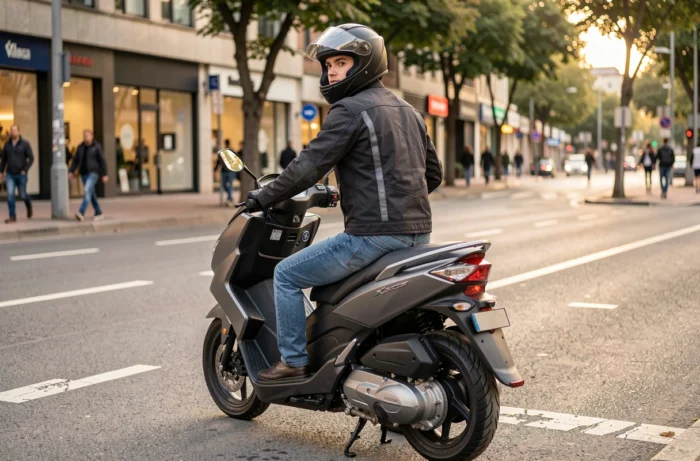
Transmission and variator Xmax 125: the main lever for gain
On a 125 cm³ restricted in power by Euro 5 standards, the engine itself offers almost no margin for improvement. The most accessible lever remains the optimization of the transmission, meaning how the engine power is transmitted to the rear wheel.
Role of the variator and weights
The variator continuously adjusts the transmission ratio. Lighter or heavier weights modify the engine’s operating range. A poorly matched set of weights can keep the engine running too high or too low in rpm, wasting available power without real gain.
Packaged preparations for Euro 5, such as those offered by Malossi, combine variator, weights, sliders, and push spring in a calibrated set. This holistic approach yields better results than an isolated replacement of a single part.
What a typical transmission pack contains
- A variator with specific slopes, which expands the operating range of the engine rpm and improves acceleration
- Weights and sliders adapted to the rider’s weight, for smoother gear changes
- A recalibrated push spring (often available in several stiffnesses depending on the rider’s size)
- Possibly a reinforced clutch spring for a more decisive engagement at low rpm
Acceleration generally improves more than top speed. The engine reaches its optimal rpm faster, the pickup is sharper, but the speed ceiling remains constrained by the engine’s maximum power.
Common mistakes that cause speed loss on the Xmax 125
Several mistakes frequently occur among owners looking to gain performance, and some actually result in speed loss instead of gain.
Worn or unsuitable belt
The transmission belt stretches with mileage. A worn belt slips, transmits power less efficiently, and can cause a loss of several km/h in top speed. Installing a new variator on a belt that has exceeded its lifespan is a waste of investment. Preparers recommend using an original Yamaha belt with less than 12,000 km when installing a transmission kit.
Weights that are too light without compensation
Lightening the weights seems logical for quicker rpm increases. In reality, weights that are too light cause the engine to run too high without gaining speed, increase consumption, and accelerate wear. The adjustment must take into account the actual weight of the rider and the usage (city, road, duo).
Ignoring the interaction with ABS and traction control
The recent Xmax 125 models integrate a traction control in addition to ABS. A modification of the transmission alters the traction behavior, especially on wet surfaces or during hard acceleration. An overly aggressive clutch or poorly calibrated weights can cause premature interventions from the traction system, paradoxically limiting performance.
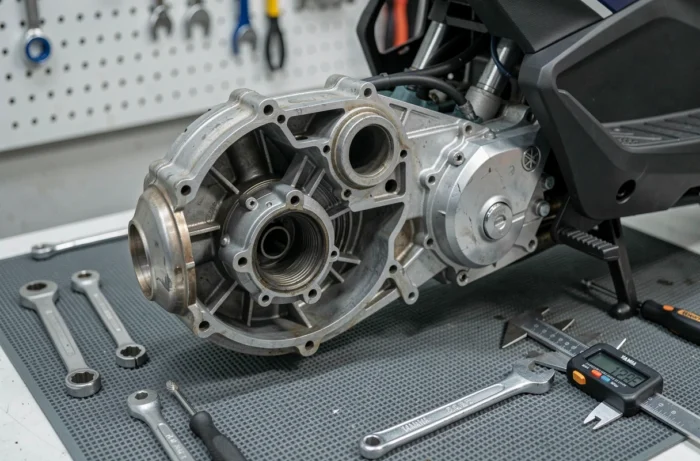
Regular maintenance and maximum speed of the Xmax 125: often neglected basics
Before investing in aftermarket parts, rigorous maintenance can sometimes restore all the performance lost over time.
- A clogged air filter reduces intake flow and restricts the engine at high rpm, where top speed is determined
- Original weights wear unevenly: a flattened area on one side creates an imbalance in the variator and degrades acceleration
- A clogged exhaust (accumulated combustion residues) limits gas evacuation and penalizes the overall efficiency of the engine
A well-maintained Xmax 125 with its original transmission regularly reaches its theoretical top speed. A neglected scooter equipped with performance parts will remain below that.
Break-in also matters. A new engine does not immediately reach its optimal performance. The first few hundred kilometers allow the internal parts to adjust, and forcing the maximum speed during this period can compromise the longevity of the engine.
Realistic gains on a Euro 5 Xmax 125, after transmission optimization and careful maintenance, are measured more in riding comfort and acceleration than in additional km/h on the speedometer. The physical ceiling imposed by 12 hp and the dimensions of a maxi-scooter remains the determining factor, regardless of the budget invested in parts.