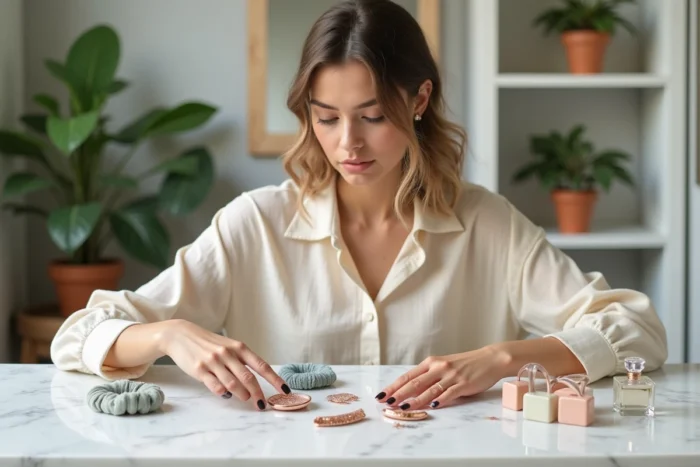
Beauty accessories are no longer stored in a pouch. Since the beginning of the year, the beauty “bag charm” trend (gloss, mini mists, lip serums worn as bag pendants) promoted by brands like Laneige and Marc Jacobs Beauty blurs the line between cosmetics and jewelry.
This shift changes the criteria for choosing where to shop: the question is no longer just about the product formulation, but also about the design of the item, its collectible aspect, and its ability to express a style.
High-tech beauty accessories at home: filtering the gadget from the effective device
The market for at-home beauty tools (LED masks, microcurrent devices, microneedling devices) is experiencing noticeable acceleration. TikTok views around beauty “LED lights” have increased by over 50% in a year, and the search term “microneedling at home” follows the same trajectory. The problem is that this popularity attracts an overwhelming supply where gadgets without proof coexist with serious devices.
We recommend checking three points before any purchase: the announced wavelength for LED phototherapy (this data should be on the product sheet, not just in the marketing pitch), the needle depth for at-home microneedling, and the CE certification of the device. A device without precise technical specifications is a warning sign.
Online specialty shops that document the technical characteristics of each reference offer a clear advantage over general marketplaces. On www.babioles-beaute.com, the selection specifically targets these original and trendy accessories, simplifying the sorting process for informed buyers.
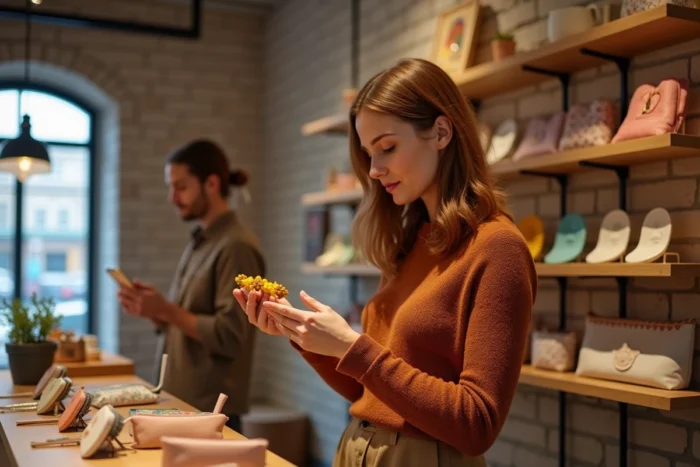
Beauty bag charms and collectible accessories: where to find original pieces
The beauty accessory has become an object of visibility and collection. Generation Z and millennials favor customizable charms, decorative patches, beauty blind boxes, and hybrid beauty-jewelry items. This phenomenon responds to a need for status and personal expression that goes beyond simple skincare routines.
To source these pieces, three channels stand out clearly from traditional circuits:
- Independent designer boutiques (artisan platforms, handmade workshops) offer hair accessories made from recycled materials, mirror brooches, and limited edition lipstick cases that are unavailable in mass distribution.
- Beauty-lifestyle specialized e-shops, which refresh their selection according to micro-trends (maximalist aesthetics, the return of color blocking), allow spotting references before they saturate social networks.
- Beauty subscription boxes increasingly include accessories (multi-shaped sponges, artistic brushes, mini sculpting tools) in addition to cosmetic products, making them a relevant discovery channel.
The discriminating choice criterion remains the rotation of the catalog. A site that has offered the same references for six months does not capture the current market dynamics.
Artistic brushes and contouring tools: the return of expressive gestures
The break with the “clean girl” aesthetic is directly reflected in the tools. The maximalist and colorful looks that have dominated makeup trends since early 2026 require detail brushes, sculpting sponges, and applicators that allow for more free gestures. A standard flat brush is no longer sufficient for applying graphic blush or gradient liner.
High-density synthetic fiber brushes have caught up with natural hair in terms of performance on creamy and liquid textures. This is a point that mainstream articles rarely mention, but it changes the quality-price ratio: a well-designed synthetic set today covers most technical gestures without requiring investment in Kolinsky or squirrel hair.
We also observe a rise in complete contouring kits (angled brush, cold sponge, mixing spatula) sold as a cohesive set rather than piece by piece. This “gesture kit” format facilitates the adoption of a technique without multiplying individual purchases.
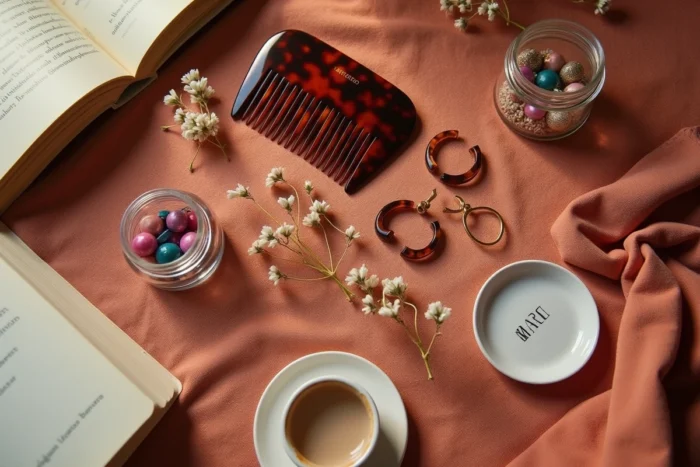
Selection of beauty accessories for face and hair routine: the criteria that matter
The facial cleansing brush remains the most favored accessory among French consumers. Its effectiveness depends on parameters that are rarely highlighted: the flexibility of the bristles (too rigid, they irritate reactive skin), the frequency of vibration, and especially the ease of cleaning the brush head, which determines long-term hygiene of use.
On the hair side, accessories made from recycled materials (woven elastics, bio-sourced acetate clips, certified wooden combs) are gaining ground. The environmental criterion is no longer a marketing bonus; it is an active purchase filter for an increasing share of the clientele.
To evaluate a beauty accessory before purchasing it, four points deserve systematic verification:
- The composition of the material in contact with the skin or hair (medical silicone, acetate, untreated wood).
- The announced lifespan and warranty conditions, often absent from product sheets on marketplaces.
- The compatibility with your existing routine (a jade gua sha is of no interest without serum or oil to facilitate sliding).
- The origin of manufacture, which impacts both the quality of finish and the product’s carbon footprint.
A well-chosen accessory enhances the effectiveness of each treatment applied. Conversely, an unsuitable tool (too porous sponge, poorly polished jade roller) can compromise the result of an otherwise effective cosmetic. The purchasing channel matters as much as the product itself: shops that precisely document the materials and uses of each reference remain the best filter against disappointing purchases.