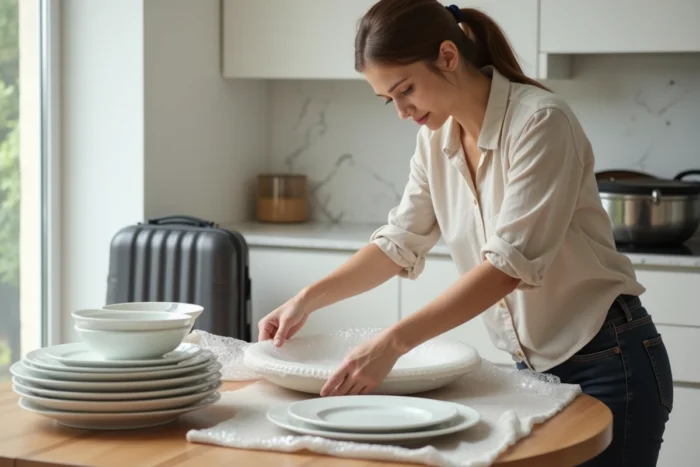
You bring back two handmade cups from a market in Lisbon, pack them in your cabin bag between a sweater and a toiletry bag, and at security, the agent asks to open the luggage. Tableware is not prohibited in the cabin, but its transport is subject to specific constraints that can be surprising if not anticipated.
Tableware in the cabin: what the regulations really allow
No European text prohibits slipping plates, bowls, or cups into a carry-on bag. Tableware does not appear on the list of prohibited items by aviation security authorities. In practice, tableware passes through security without issue as long as it does not have sharp edges or a shape that could be considered a blunt object.
The trap comes more from weight and volume. A set of four stoneware plates easily weighs over a kilogram, which eats into the cabin allowance. Most airlines cap the standard carry-on bag between seven and ten kilograms. Exceeding this limit due to ceramics purchased while traveling risks a forced upgrade to checked baggage, with the associated risks of breakage.
When preparing for the transport of tableware in cabin baggage, the first check is therefore on the exact allowance of the airline booked. Since the summer of 2025, European regulations require airlines operating in Europe to allow at least one small personal bag of 40 × 30 × 15 cm under the seat for free, without additional charges. This volume is sufficient for a few lightweight items (cups, small bowls), provided they are packed correctly.
Packing fragile tableware for a cabin flight
The cabin has a clear advantage over the hold: you control the shocks. No conveyor belt, no stacking of suitcases. However, the overhead compartment experiences jolts during takeoff and landing, and other passengers may push their own luggage against yours.
Effective packing materials without excess weight
Wrapping each piece individually remains the basic rule. You can use:
- Thin bubble wrap (two layers are sufficient for a ceramic cup), secured with tape.
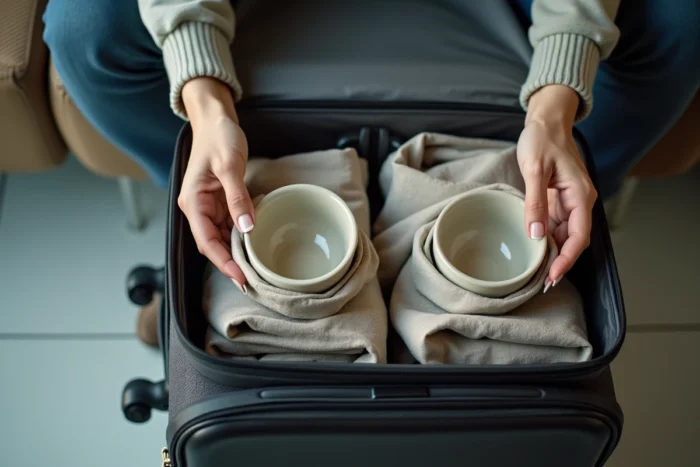
- Clothes rolled around each piece, a technique that costs nothing and adds no weight since the clothes were already in the bag.
- Thick socks slipped inside bowls or cups to absorb vibrations and prevent direct nesting.
A common mistake is to stack several plates without separation. Even cushioned in fabric, they rub against each other and the edges chip. Inserting a sheet of paper or fabric between each piece eliminates this problem.
Arrangement in the cabin bag
Pack the wrapped tableware in the center of the bag, surrounded by clothes or soft items that act as cushioning. The heaviest pieces (platters, large plates) go at the bottom, the lighter ones on top. If the bag has a rigid compartment or a padded pocket for a laptop, it’s a good spot for a well-wrapped flat plate.
Airport security: anticipating checks
At the scanner, ceramic tableware appears as a dense, uniform mass. Agents regularly ask to open the bag for a visual inspection, especially when several pieces are stacked. This is not a refusal; it’s a routine check.
To speed up the process, you can place the tableware in a separate bag inside the luggage, making it easy to pull out and show. A few extra seconds of checking, but no unpleasant surprises. If the tableware is a gift still wrapped in opaque paper, it will likely need to be unwrapped: it’s better to wrap the gift after landing.
Responses vary on this point depending on the airports: some state-of-the-art scanners, like those gradually deployed in Vienna or other European hubs, allow you to leave items in the bag without removing liquids or electronic devices. Tableware usually passes through without manual inspection in most cases.
Cabin or hold: when to switch tableware to checked baggage
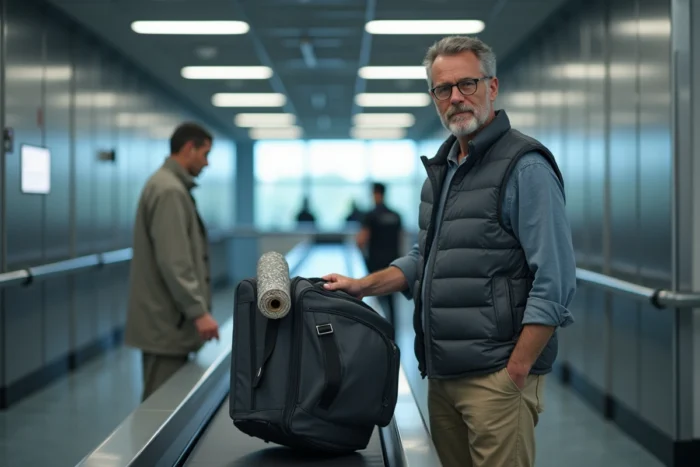
The cabin is suitable for a few lightweight pieces. Beyond four or five plates, or for bulky items (serving bowls, platters), the hold becomes more appropriate provided the packaging is reinforced. In the hold, the luggage is mechanically handled, sometimes thrown onto a conveyor. Without solid protection, breakage is almost guaranteed.
The mixed strategy works well: the most valuable or fragile pieces (a fine porcelain cup, a handmade bowl) travel in the cabin, under our control. The rest, better protected in a hard suitcase with thick bubble wrap, goes in the hold.
- In the cabin: cups, small bowls, lightweight and fragile pieces, items of sentimental value.
- In the hold: heavy plates, serving platters, bulky sets, provided a hard-shell suitcase is used.
- To avoid everywhere: stemware, crystal carafes without dedicated boxes, already cracked pieces that won’t withstand pressure variations.
Since 2025, the requirement to display the total price including cabin baggage at the time of booking makes it easier to compare airlines. You know before purchasing your ticket if the cabin allowance is sufficient for the few pieces of tableware planned, or if it’s better to pay for checked baggage upfront rather than at the boarding counter, where the fee is always higher.
Bringing back tableware by plane is not complicated when you respect weight limits, wrap each piece separately, and choose the right compartment based on quantity. The real risk is not the regulation; it’s breakage due to negligent packing.