A home vegetable garden is based on a principle often underestimated: the quality of the soil determines the harvest much more than the choice of vegetables. Before sowing anything, understanding the soil, its biological functioning, and its structure helps avoid most common failures. The most effective gardening tips all stem from this foundation.
Living soil and no-dig method: the foundation of a productive vegetable garden
The no-dig technique consists of never turning the soil. The soil is covered with compost and organic mulch, layer by layer, to nourish the microorganisms that naturally structure the substrate.
Turning the soil with a spade destroys worm tunnels, exposes mycorrhizal fungi to light, and disrupts the exchanges between roots and soil fauna. With no-dig, underground life remains intact and works for you.
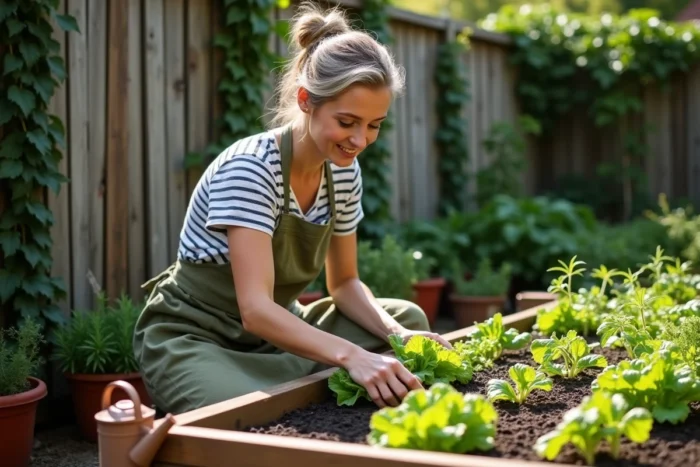
In practice, lay a layer of unprinted brown cardboard on the grass or bare soil, then cover it with ten to fifteen centimeters of mature compost. Add a mulch of straw, hay, or fallen leaves. You can plant directly in the compost from the very first season. To delve deeper into suitable varieties and cultivation techniques, the vegetable garden on Tradition Jardin details associations and sowing calendars by vegetable.
The soil improves each year without mechanical effort, provided it is never left bare. After each harvest, add mulch or sow a green manure.
Permanent beds and intercropping: organizing space to harvest more
The spatial organization of the vegetable garden directly influences yield. The method of permanent beds is based on a simple layout: strips of cultivation about 1.20 m wide, separated by paths of 40 to 50 cm.
This width is not arbitrary. It allows you to reach the center of the bed from each side without ever stepping on the cultivated soil. The soil remains loose, aerated, and uncompacted. The paths can be covered with wood chips or straw to limit weeding.
Intercropping and succession to avoid production gaps
A vacant bed between two harvests represents wasted time. The idea of intercropping is to associate vegetables with different growth rhythms on the same bed.
- Sow radishes (harvested in three to four weeks) between tomato plants that will take several months to produce. The radishes will be gone before the tomatoes need the space.
- Plant cut-and-come-again salads at the foot of climbing beans. The salads benefit from the light shade created by the foliage above.
- After harvesting fava beans in spring, transplant zucchinis in the same bed. The fava beans have fixed nitrogen in the soil, which directly benefits the cucurbits.
This principle of succession also prevents soil depletion. Alternating botanical families from one season to the next reduces the pressure from specific pests and balances nutrient uptake.
Deep watering: saving water while strengthening plants
Most home vegetable gardens suffer from too frequent and too shallow watering. Water moistens the top few centimeters of soil, roots remain near the surface, and the plant becomes dependent on daily inputs.
Watering less often but deeply forces the roots to go down to seek moisture. A tomato plant whose roots reach twenty or thirty centimeters deep withstands a heat wave much better than a plant watered daily at the surface.
When and how to water a vegetable garden effectively
The ideal time is early in the morning. Evaporation is low, and the foliage has time to dry before nightfall, which limits the development of fungal diseases (downy mildew, powdery mildew).
Always water at the base of the plants, never on the leaves. A microporous hose laid along the permanent beds works well: it slowly diffuses water directly at the root level. The mulch placed on top further reduces evaporation.
For fruiting vegetables (tomatoes, peppers, eggplants), two generous waterings per week during hot periods are usually sufficient. Salads and radishes, whose roots remain shallow, require more frequent but moderate watering.
Functional biodiversity in the vegetable garden: attracting beneficial auxiliaries
A vegetable garden without beneficial insects requires manual intervention against every pest. Promoting functional biodiversity means creating an ecosystem where natural predators regulate aphid, caterpillar, and slug populations themselves.
Flowering strips sown at the edge of the vegetable garden attract hoverflies, lacewings, and ladybugs. These insects lay their larvae near aphid colonies, which they feed on. Common marigold, phacelia, and crimson clover fulfill this role while covering bare soil.
Leaving a small pile of dead wood or stones in a corner of the garden provides shelter for ground beetles, which hunt slugs at night. A simple upside-down terracotta pot filled with straw attracts earwigs, effective predators of woolly aphids.
- Avoid any insecticide, even organic, as it also eliminates beneficials.
- Let a few carrot, fennel, or dill plants flower: their umbels attract parasitic wasps that lay eggs in caterpillars.
- Install a small water point (a dish with pebbles) so that pollinating insects can drink.
A vegetable garden rich in auxiliaries requires less maintenance each year, as the biological balance strengthens over the seasons. The first weeks may seem chaotic, with visible aphids on some plants, but predators are always close behind.
The greatest lever remains patience. A living soil that is permanently covered, well-organized beds, controlled watering, and a few shelters for beneficial wildlife are enough to transform a simple patch of earth into a resilient vegetable garden capable of producing healthy vegetables season after season.