
The first half of the year has reshuffled the cards across several technical segments. Between the tightening European regulations on connected objects, the new constraints of the AI Act for small studios, and the arrival of redesigned chips from major foundries, this year’s high-tech and geek landscape cannot be summarized as just a list of gadgets.
Cyber Resilience Act: What Changes for Connected Hardware
The Cyber Resilience Act and the European regulation on products with digital elements now impose cybersecurity requirements on almost all connected hardware sold in Europe. Watches, speakers, smart home sensors, gaming accessories: every connected object must integrate security by default before hitting the market.
Manufacturers are required to ensure robust authentication, encryption of communications, and long-term software support. In case of non-compliance, the product may be withdrawn from the European market. For smart home and wearable enthusiasts, the direct consequence is a gradual reduction in devices abandoned after a few months without updates.
We are already observing a scheduling shift among several Asian brands that are adapting their ranges to meet mandatory compliance through evaluation bodies. Early adopters following tech news on littlegeek.fr will note that security labels are beginning to appear on product sheets, a purchasing criterion to watch closely.
AI Act and Geek Projects: Constraints for Micro-Studios
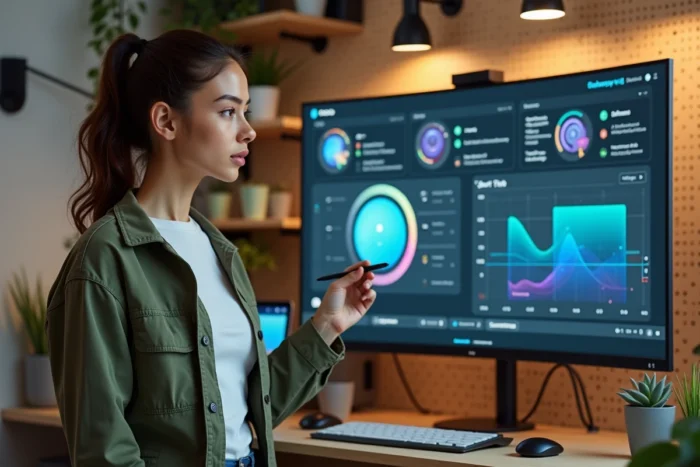
The European AI Act does not only target large companies. Start-ups and micro-studios that integrate artificial intelligence into their games, mobile applications, or connected objects are also affected. The risk-based classification requires each publisher to document the functioning of their models, even for an independent project distributed on a store.
A solo developer publishing a tool based on an LLM must now provide a compliance assessment. The cost and time required for this documentation hinder the quick releases that characterized the indie scene. The European Parliament has already initiated a targeted revision of the legal framework, indicating that the initial text posed applicability issues for small structures.
For tech enthusiasts developing side projects, the constraint is real. A chatbot integrated into a game mod or a custom voice assistant potentially falls under the AI Act as soon as it is accessible to the European public.
Chips and GPUs: Renewal of Intel and Apple Architectures
Intel continues its roadmap with a new generation of processors targeting both the mobile segment and workstations. The focus is on efficiency per watt, a crucial criterion for gaming laptops and ultrabooks aimed at creatives.
Apple, for its part, continues to widen the gap on vertical integration. The latest M-series chips push the limits of performance-to-consumption ratio for video rendering and local inference tasks. AI inference directly on the chip, without cloud calls, becomes a concrete selling point for privacy-conscious users.
- On the Intel side, the new hybrid cores optimize the distribution of workloads between heavy tasks (compilation, 3D rendering) and light tasks (browsing, office work), resulting in a noticeable gain in battery life.
- Dedicated GPUs are making progress in real-time ray tracing, making real-world game testing more demanding for traditional benchmarks.
- The mini-PC segment is gaining power: several recent models rival mid-range towers from two years ago, in a format that fits on a shelf.
Impact on the Smartphone Market
The high-end smartphone now integrates NPUs (Neural Processing Units) capable of running language models locally. This trend, driven by Apple and followed by Qualcomm, alters the hierarchy of purchasing criteria: the raw power of the SoC matters less than its ability to handle AI tasks without network latency.
The NPU becomes the differentiating component of the premium smartphone. Tests show that offline voice recognition and computational photography are smoother compared to the previous generation.

Connected Objects and Home Automation: The Matter Software Convergence
The Matter protocol, supported by Apple, Google, and Amazon, has reached sufficient adoption to change purchasing habits in home automation. Matter-compatible products communicate with each other without relying on a proprietary hub, simplifying multi-brand installations.
Matter eliminates ecosystem lock-in for connected home objects. A Matter-certified bulb works interchangeably with HomeKit, Google Home, or Alexa, without the need for an additional gateway. For geeks who stacked Zigbee and Z-Wave bridges, the gain in simplicity is tangible.
Combined with the requirements of the Cyber Resilience Act, Matter pushes manufacturers to maintain their firmware for longer. A temperature sensor sold today will need to receive security patches for several years, whereas some entry-level models were previously abandoned as soon as they hit the shelves.
Video and Streaming: 8K Remains Marginal
Despite the presence of a few 8K televisions in catalogs, native content remains almost non-existent. Streaming offerings top out at 4K HDR, and the bandwidth required for 8K far exceeds what most home internet connections can provide. We recommend focusing the budget on image processing quality (upscaling, HDR management, refresh rate) rather than on raw resolution.
This year confirms an underlying trend: the added value is shifting from hardware to software and regulation. The most relevant high-tech products are not necessarily the most spectacular, but those that guarantee sustainable software maintenance, solid regulatory compliance, and real interoperability between ecosystems. The choice of a connected object or mobile terminal is now made as much on its technical specifications as on its long-term support commitment.