
The red spots that appear on a newborn’s skin do not all look the same. Their location, appearance, and associated symptoms point to very different causes, ranging from a simple hormonal reaction to a viral infection requiring medical advice. To clarify, sorting by type of lesion and age group helps distinguish what is benign from what warrants a quick consultation.
Red spots in infants: sorting by appearance and location
Not all red spots require the same reaction. The table below compares the most common rashes in babies according to their appearance, the affected area, and the recommended action.
| Type of rash | Typical appearance | Main location | Recommended action |
|---|---|---|---|
| Infant acne | Small red or white spots, sometimes with a white head | Face (cheeks, forehead, chin) | No treatment, spontaneous disappearance in a few weeks |
| Toxic erythema | Red papules with a yellowish center | Trunk, arms, thighs | Benign, disappears in the first days of life |
| Heat rash (miliaria) | Small red vesicles, sometimes translucent | Folds of the neck, armpits, back | Cool down, lighten clothing |
| Eczema (atopic dermatitis) | Red, dry, rough patches with itching | Cheeks, folds of elbows and knees | Daily emollients, consultation if persistent |
| Diaper rash | Bright redness, irritated skin | Diaper area | Frequent changes, protective cream |
| Roseola | Rash of small pink spots appearing after a high fever | Trunk, then neck and face | Medical consultation to confirm, symptomatic treatment for fever |
This table covers the most common cases. When the red spots on the baby’s body are accompanied by fever, bleeding lesions, or a change in behavior, medical advice is necessary without delay.

Baby rashes related to heat and sun: two underestimated causes
Heat rashes are often mentioned, but there is confusion between two distinct phenomena: miliaria (blockage of sweat glands) and solar erythema (sunburn). In infants, the skin burns much faster than that of an adult.
Current recommendations are clear: any direct sun exposure should be avoided before the age of six months. A baby who shows diffuse redness on exposed areas after a summer outing does not necessarily suffer from “heat rash.” It could be a true sunburn, which requires different management.
Miliaria or sunburn: differentiating to act
Heat rashes concentrate in the folds (neck, armpits, groin) and appear when the baby is too hot, even indoors. Sunburn, on the other hand, affects exposed areas (forehead, shoulders, arms) and is accompanied by warm skin to the touch.
- Miliaria: lighten clothing, prefer cotton fabrics, ventilate the room without exposing the baby to a direct draft
- Sunburn: hydrate the skin with a suitable emollient, avoid further sun exposure and consult if the redness is intense or if blisters appear
- Common prevention: mosquito net and covering clothing rather than sunscreen before six months, as sun filters are not recommended at this age
Insect bites in infants: red papules often confused with other rashes
Pediatricians and teleconsultation services report an increase in consultations for red papules related to mosquito bites in babies. Warmer and longer summers partly explain this trend.
The problem is twofold. The infant’s skin reaction to bites is often more pronounced than in adults: a simple mosquito bite can swell, redden, and resemble a urticaria or eczema lesion. Parents then confuse the bite with a skin disease.
Repellents and infants: what is prohibited
Topical repellents are prohibited before the age of two months, and those containing DEET are strictly limited before two years. The only recommended protection for babies under six months relies on physical barriers.
- Mosquito net on the crib and stroller, preferably impregnated
- Long, lightweight clothing covering arms and legs
- No application of repellent directly on the skin of infants under six months
When a bite causes rapid swelling of the face or breathing difficulties, it is no longer just a local reaction. It is an emergency.
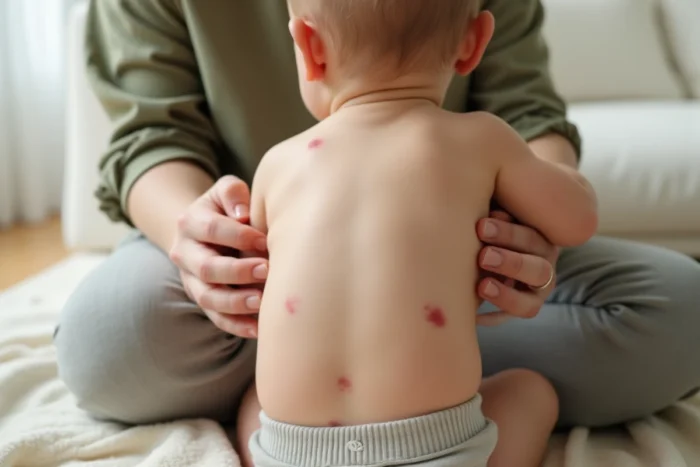
Roseola and eruptive diseases: when fever precedes the spots
Roseola (or sixth disease) illustrates a pattern that confuses many parents: high fever appears first, then the spots emerge when the fever drops. The infant seems to feel better at the very moment the rash appears on the trunk.
This sequence is distinctly different from chickenpox, where vesicles and fever coexist, or measles, where the rash follows a phase of respiratory symptoms. Roseola primarily affects children between six months and two years and generally requires only treatment for fever.
Warning signs not to ignore
Among the skin rashes in infants, some require immediate consultation. Lesions that bleed, develop a yellowish crust, or spread rapidly may indicate a superinfection. Red spots associated with persistent fever beyond three days warrant medical advice.
An infant who refuses to eat, becomes abnormally drowsy, or has purplish spots that do not fade under pressure (glass test) should be seen urgently. This last sign may indicate purpura, a rare but serious condition.
The majority of red spots in infants disappear on their own within a few days. The most useful reflex remains observation: noting the location, evolution, and associated symptoms allows the doctor to make an accurate diagnosis during the consultation.