
Avenir Conseil Formation is an organization based in Bezons, in the Val-d’Oise, which has been claiming to provide continuing education for about twenty years. Its website presents various programs, from job placement to apprenticeship contracts, as well as pathways for employees. What does the structure of this offering reveal when compared to the signals sent by other entities of the same name in the training ecosystem?
Local proximity versus digital learning: two models under the same name
The name “Avenir Conseil” actually refers to several distinct entities within the landscape of French professional training. This partial homonymy creates a confusion that navigation between the sites does not always clarify.
Avenir Conseil Formation (ACF), based in Bezons, positions itself as a human-sized organization rooted in Île-de-France. Its centers are spread throughout the region, and the close relationship with clients is a central argument in its discourse. Trainers are recruited for their sector expertise, and the content is updated according to regulatory changes.
By consulting the overview of the Avenir Conseil Formation site, one can identify sectors aimed at specific audiences: job seekers, young people aged 16 to 30 in apprenticeships, and employees upskilling. The professional titles offered (Establishment Manager, Retail Manager, Sales Advisor, Commercial Employee, Executive Assistant, CAP AEPE) outline a profile focused on commerce and support functions.
On the other hand, Avenir Conseil (without “Formation”) has developed a digital learning branch through edufactory, its integrated agency. This entity targets large industrial accounts and the public sector, with UGAP referencing as the exclusive supplier in the market for custom digital training for the period 2023-2026. The scope is entirely different: we are talking about distance learning programs reaching over one hundred fifty thousand learners per year.

Comparison of training positions: ACF Bezons versus the Avenir Conseil group
| Criterion | Avenir Conseil Formation (Bezons) | Avenir Conseil / edufactory |
|---|---|---|
| Location | Bezons (95) and centers in Île-de-France | National presence, public markets |
| Target audience | Job seekers, young apprentices, employees | Large industrial accounts, public sector |
| Dominant format | In-person, local support | Custom digital learning, blended learning |
| Public referencing | Not mentioned | Exclusive UGAP supplier (3rd consecutive referencing) |
| Structure size | Human-sized organization | Group with integrated agency (edufactory) |
| Sector specialization | Commerce, support functions, early childhood | IT, engineering, manufacturing, business IT |
This table highlights a structural gap. The two entities share part of their name, but their markets hardly overlap.
What this gap means for a learner seeking training
A job seeker in Val-d’Oise looking for a professional title in sales has no use for a digital learning platform designed to train the teams of an industrial group. Conversely, a training manager in a local authority will not find at ACF Bezons the digital pedagogical design tools they are looking for.
Verifying the correct entity before any registration process remains the most useful precaution. The URLs differ (acformations.net for ACF, avenir-conseil.fr for the group), but search results regularly mix the two.
Professional training programs offered by ACF Bezons
The offering from Avenir Conseil Formation is structured around three axes, each addressing a different status of the beneficiary.
- The basic skills pathway, aimed at job seekers, aims to consolidate fundamental knowledge and prepare for a return to employment or entry into qualifying training
- The apprenticeship contracts, open to young people aged 16 to 30 and job seekers over 26, allow for the validation of professional titles ranging from CAP AEPE to establishment manager level
- The training for employees, within the framework of the skills development plan or the personal training account, covers topics related to management, professional qualification, and job practices
This segmentation by status is classic for a continuing education center. What distinguishes ACF is more its territorial network in Île-de-France than any particular pedagogical innovation.
Trainers and content updates
ACF emphasizes a selective recruitment of its trainers, chosen for their expertise in a specific field. The knowledge transmitted is updated according to regulatory, technological, or ethical developments, according to the organization’s communication.
This approach corresponds to what is expected from a certified training center that keeps its content up to date. However, the question of the actual frequency of these updates, and their traceability, remains open for any organization of this size.
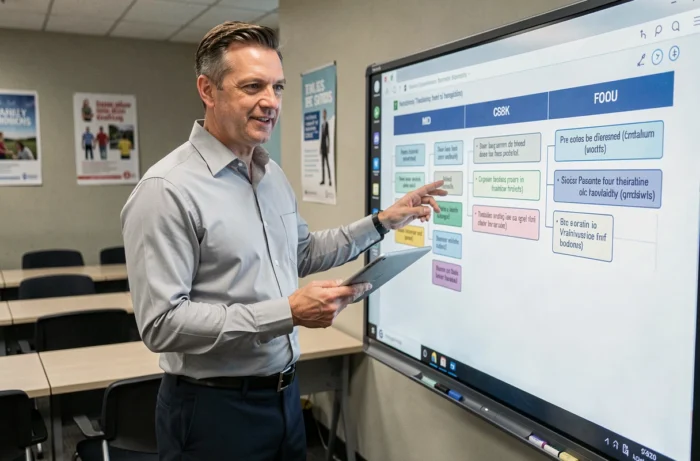
Qualification and diploma: professional titles accessible via ACF
The professional titles prepared at Avenir Conseil Formation primarily cover the commerce and operational management sectors. Five titles and one diploma are identifiable in the offering:
- Establishment Manager
- Retail Manager
- Sales Advisor
- Commercial Employee
- Executive Assistant
- CAP Educational Assistant for Young Children (CAP AEPE)
These certifications are listed in the National Directory of Professional Certifications, making them eligible for various funding schemes. For an independent candidate or an employee seeking a qualification recognized in commerce or early childhood, this panel remains consistent with the positioning of a local organization.
The CAP AEPE represents a notable specificity in the offering. This diploma, highly sought after in Île-de-France, opens up prospects in early childhood care facilities and nursery schools. Its presence alongside commerce-oriented titles reflects a measured desire for diversification.
The offering from Avenir Conseil Formation does not claim to cover the entire spectrum of professional training. Its scope, focused on directly employable operational skills, corresponds to a local proximity center model that embraces its specialization rather than dispersing its resources across dozens of sectors.