Going for a day hike in the forest or spending a night in the mountains requires different gear. However, the choice of outdoor equipment is based on a few common principles that help avoid unpleasant surprises once you’re on the ground. Before filling a backpack, it’s better to understand what distinguishes suitable gear from unnecessary purchases, especially as camping regulations evolve and restrict options.
Camping Regulations in France: What Changes for Your Gear
Have you already planned a night under a tent near an alpine refuge? The practice of camping along iconic routes is becoming more regulated. Around the refuges in the Chamonix valley (Albert 1er, Couvercle, Envers des Aiguilles, Argentière), camping spots are now precisely marked. “Red zones” prohibit any setup, particularly near water catchments, refuge terraces, and helicopter landing areas.
This tightening has a direct impact on the gear to bring. Free camping with a traditional tent is retreating on the most frequented routes. Fires are prohibited, waste management must be self-sufficient, and refuge toilets become mandatory when they exist nearby.
Another often overlooked point: in French law, the term “bivouac” does not have a unique national definition. The Urban Planning Code refers to “isolated camping,” and the term bivouac only appears in the Environmental Code for national parks and nature reserves. Rules therefore vary from one mountain range to another. Checking local regulations before each outing has become a full-fledged preparation step.
In practice, this leads to a compact and lightweight tent, a dedicated trash bag for organic waste, and an approved stove rather than a campfire. “All-terrain” gear gives way to equipment designed for regulated, sometimes reserved areas.
Sleeping Gear for Hiking: How to Avoid Common Mistakes
The trio of tent, sleeping bag, and sleeping pad accounts for the majority of weight in a backpack. It also concentrates the majority of purchasing mistakes. To find the gear available on L’Esprit Nature that suits your practice, a few technical guidelines help sort through the options.
Hiking Tent: Weight vs. Livability
An ultralight tent increases comfort on the trail, but it reduces interior space and wind resistance. For summer outings in the mid-mountains, a two-person freestanding tent offers a good compromise. Non-freestanding models, secured by stakes and guy lines, are suitable for soft ground but pose problems on rocky slabs where nothing can be anchored.
Test the setup of your tent at home before departure. A clumsy setup in the rain, with a headlamp, turns a peaceful evening into a struggle.
Sleeping Bag: Comfort Temperature, Not Extreme Temperature
Manufacturers often display the “extreme” temperature on the packaging. This value corresponds to the survival threshold, not the threshold for proper sleep. The “comfort” temperature, which is more reliable, indicates the range in which an average sleeper stays warm without curling up.
For most camping trips between spring and autumn, a sleeping bag with a comfort temperature around zero degrees covers the majority of situations in the mountains. In the plains or during summer, a lighter model is sufficient.
Sleeping Pad: Thermal Insulation Above All
The pad is not just for cushioning against rocks. Its main role is to insulate from the cold rising from the ground. A high-performance sleeping bag placed directly on bare earth loses a significant part of its effectiveness. Insulated inflatable pads offer the best insulation-to-volume ratio, but they are prone to punctures. Foam pads, more rugged, remain reliable in all conditions.
Outdoor Clothing and the Three-Layer System
Why do some hikers stay dry during a storm while others shiver despite a brand-new jacket? The answer rarely lies in the price of the clothing. It has to do with how the layers are combined.
The principle of the three layers works as a regulation system:
- The base layer, worn against the skin, wicks away sweat. Synthetic materials or merino wool fulfill this role. Cotton, on the other hand, absorbs moisture and cools the body, making it the worst choice for outdoor activities.
- The mid-layer retains body heat. A lightweight fleece or a thin synthetic down jacket is suitable for most seasons.
- The outer layer protects against wind and rain. A breathable waterproof jacket prevents water from entering while allowing water vapor to escape.
A good three-layer system costs less than a single high-end technical jacket, and it adapts to all conditions by adding or removing a layer according to effort and weather.
Hydration and Nutrition on Outdoor Trips
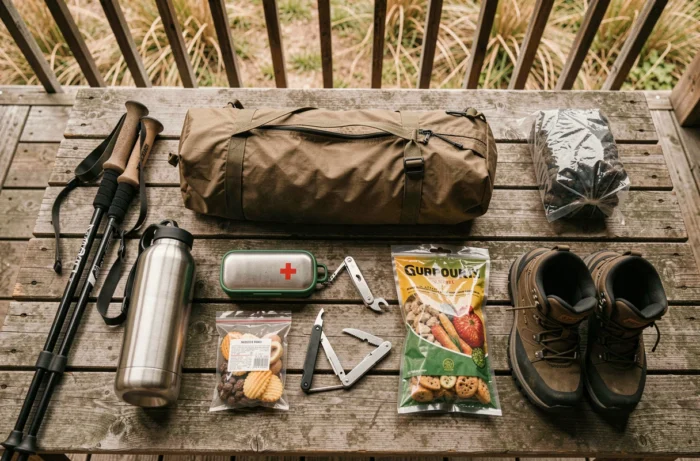
Carrying enough water seems obvious. Knowing how to make it drinkable when sources are not guaranteed is much less so. When camping or on long hikes, there are three purification options: chemical tablets (effective but slow), pump or gravity filters (fast, reusable), and integrated filtering water bottles (convenient for day trips).
For food, freeze-dried meals remain the standard for camping due to their low weight. They simply require hot water and a compact stove. Bringing an approved stove and a gas cartridge suitable for the outside temperature avoids unpleasant surprises: some cartridges lose pressure below five degrees.
Hiking Backpack: The Container That Determines the Content
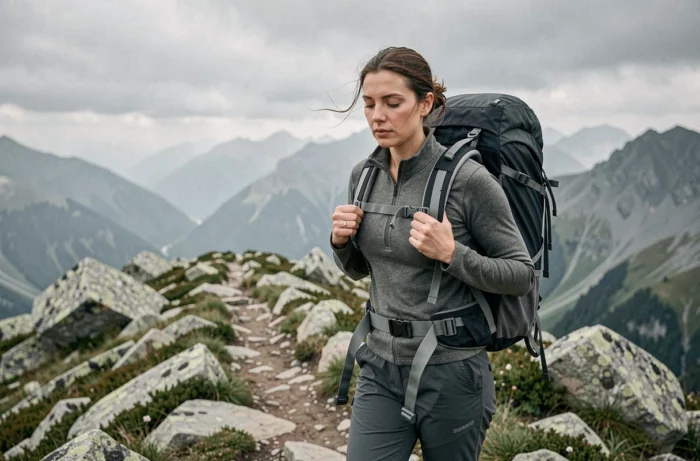
The volume of the backpack dictates what you can bring. For a day, a backpack of twenty to thirty liters is sufficient. For an overnight camp, count on forty to fifty liters. Beyond that, the backpack becomes heavy and unbalances your walk.
Adjusting the backpack is as important as its volume. The hip belt should rest on the hips, not on the waist. The straps should be adjusted so that the weight is distributed between the shoulders and the hips. A poorly adjusted backpack causes back pain within the first hour of walking.
- Store heavy items (water, food, stove) in the center of the backpack, close to the back.
- Place the sleeping bag and spare clothes at the bottom, in a waterproof bag.
- Keep the waterproof jacket, map, and headlamp accessible at the top or in the side pockets.
One last often overlooked point: the rain cover of the backpack does not protect the contents on its own. Seams and zippers allow water to enter during prolonged downpours. Doubling the protection with waterproof inner bags remains the safest method to keep your sleeping gear and clothes dry.